

Why AI-driven credit scoring matters for crypto lenders right now
If you run or build a crypto lending product, you’ve probably noticed a frustrating gap: the demand for undercollateralized or partially collateralized loans is huge, but traditional credit scoring just doesn’t plug into Web3. Banks rely on payroll data, bank statements and national credit bureaus. On-chain users often have none of that, yet they may operate high-value wallets, trade actively, provide liquidity and manage risk better than many “prime” bank customers. AI-driven credit scoring tries to close this gap by translating messy, fragmented on-chain and off-chain signals into a single, machine-readable risk profile that a lending engine can actually use. That is the core promise behind AI credit scoring for crypto lending platforms: make risk visible where legacy systems see only a blank space, and do it in an automated, scalable way that matches the speed and transparency expectations of Web3 users.
Историческая справка: от формальных кредитных бюро к on-chain репутации
The roots of algorithmic credit scoring go back decades, but the crypto twist is fairly recent. Initially, centralized exchanges and early lending desks used almost no intelligence at all: everything was either fully collateralized or based on manual, human risk committees evaluating institutional clients. Retail borrowers essentially had two options: overcollateralize or get nothing. There was no serious notion of AI-based risk assessment solutions for cryptocurrency lenders, because the industry was busy solving more basic issues like custody, security and regulatory classification of tokens. That changed once DeFi protocols and CeFi lenders started to realize how capital-inefficient pure overcollateralization is, especially in volatile markets where collateral haircuts need to be aggressive to protect pools during crashes.
Around 2019–2021, interest in behavioral analytics and on-chain reputation grew fast. The first wave of experimentation focused on simple metrics: wallet age, transaction counts, DEX volume, liquidation history on lending protocols. These heuristics helped, but they were still too naive to support serious underwriting. As market cycles exposed risk management failures, especially in the wake of large centralized lender collapses, the appetite for more systematic, data-driven tools increased. This is the period when prototypes of machine learning credit scoring software for crypto loans started to appear, connecting exchange data, blockchain explorers, decentralized identity frameworks and off-chain KYC data. The narrative shifted from “collateral or nothing” to “data-rich borrowers can earn access to cheaper, more flexible credit even without perfect traditional scores.”
Базовые принципы AI-driven кредитного скоринга в крипте
At its core, AI-driven credit scoring for crypto lenders is about mapping three big data domains into a single risk score: identity, cash flows and behavior. Identity answers “who is this entity, roughly speaking,” cash flows answer “what kind of financial capacity do they have,” and behavior deals with “how do they react to stress, volatility and incentives.” In a crypto-native context, all three are tricky. On-chain data is pseudonymous, fragmented across chains and addresses, and heavily influenced by market cycles. Off-chain data, like income verification, often lives behind centralized APIs and is limited by regulation and user consent. A robust scoring system needs to aggregate these sources, normalize them and feed them into models that are robust to noise, adversarial behavior and regime changes.
Modern AI credit scoring for crypto lending platforms usually relies on a pipeline that looks something like this: data ingestion, feature engineering, model inference, and policy enforcement. Data ingestion pulls on-chain transactions from multiple networks, exchange balances, social and reputational signals, identity verification outputs and sometimes even device fingerprints. Feature engineering transforms raw events into interpretable signals such as “average net flow per month,” “historical leverage ratio,” “liquidation density during market drawdowns,” or “counterparty risk exposure via smart contracts interacted with.” Machine learning then converts these feature vectors into probability-of-default estimates or loss-given-default distributions. Finally, a policy engine maps those probabilities into concrete terms: maximum loan size, collateral ratio, interest rate tiers, and additional conditions like margin call thresholds.
Ключевые источники данных и метрики

In practical deployments, crypto lenders that use AI-based risk assessment solutions for cryptocurrency lenders tend to converge on a similar set of data pillars. The first pillar is on-chain transactional data, where you care about wallet longevity, interaction graph, gas spending patterns, contract interaction diversity and history of participating in lending, staking, or yield strategies. The second pillar is off-chain financial and identity information: KYC records, exchange KYC tiers, fiat inflows and outflows, card or bank integrations where regulators allow that. The third pillar is behavioral and reputational: frequency of identity changes across platforms, device and IP consistency, dispute history, and even governance or social reputation scores. Combining these pillars allows the model to distinguish between, say, a sophisticated long-term market maker and a newly created, single-purpose wallet trying to extract a fast loan and disappear.
Typical feature sets for machine learning credit scoring software for crypto loans are surprisingly rich. On-chain, you might track stablecoin versus volatile asset balances, participation in liquidity pools, realized PnL on DEXs over rolling windows, and exposure to high-risk protocols or bridges with a history of exploits. Off-chain, you can use KYC tiers, document verification quality, AML flags, chargeback rates if fiat rails are involved, and device-level anomaly detection. Behavioral patterns include timing of deposits and withdrawals relative to market events, use of privacy layers, clustering of addresses that move assets in lockstep, and patterns of responding to margin calls. The AI models—often gradient boosting, deep neural nets or graph-based architectures—are trained on historical borrower cohorts where labels come from observed loan performance, defaults and workout outcomes.
Как AI превращает данные в решения по кредитным лимитам
From a lender’s point of view, the value is not in the raw probability-of-default number but in what it allows you to safely offer. AI-driven scoring systems are typically embedded directly into origination and risk engines, so that score updates automatically propagate into real-time lending decisions. For example, a borrower with a long, clean on-chain history, stable net inflows and a track record of repaying loans across several protocols might qualify for lower collateralization ratios and better rates. Conversely, an address cluster that looks like it was spun up yesterday, interacts mainly with high-risk mixers, and shows aggressive leverage in volatile tokens would be restricted or fully blocked. These are not static rules; AI systems can re-evaluate risk scores based on new transactions or market conditions, which is especially important in crypto where volatility can reshape a user’s risk profile within hours.
Pragmatically, deploying blockchain lending platforms with AI credit checks means integrating scoring APIs tightly with your loan origination flow. On user onboarding, you trigger identity and device checks, tie them to wallet addresses, and request permission for off-chain financial data where applicable. Before a loan is issued, the platform fetches or computes a real-time risk score, applies a decision policy, and returns either approved terms or a denial with reasons that can be simplified for the user. Post-origination, scores are continuously monitored; if a user starts routing funds through suspicious contracts or racks up losses across DeFi protocols, the system can tighten terms, reduce credit limits, or require additional collateral. This feedback loop is what turns static scoring into dynamic, AI-driven risk management.
Примеры реализации и практические сценарии
Let’s walk through concrete patterns where AI credit scoring for crypto lending platforms is already moving from slide decks to production. Consider a cross-margin trading platform that wants to offer borrowers leverage based on their multi-exchange and on-chain profile instead of fixed tiers. By wiring in AI-scored risk buckets, the platform can calculate custom leverage caps per user. Low-risk traders—those with stable PnL curves, disciplined stop-loss usage and no fraud flags—receive higher leverage at lower interest rates. High-risk users still get access but at more conservative parameters. This personalization not only reduces tail-risk for the platform but also makes the product stickier, because users perceive that their good behavior is rewarded in a tangible way.
Another scenario: a lending protocol wants to break out of pure overcollateralization by introducing partially collateralized loans for selected wallets. The protocol integrates AI-powered KYC and credit scoring tools for DeFi lenders into its smart contract layer via oracles or trusted off-chain agents. When a user requests a loan, the contract queries an oracle for that user’s risk band. If the band is “prime,” the contract allows, say, 50% collateralization instead of 100%, with slightly higher rates but still attractive compared to unsecured consumer credit. If the band is “near-prime,” the protocol may require more collateral or cap the term length. This approach mixes on-chain transparency—anyone can see the rules—with off-chain intelligence, where the AI models evolve as more performance data accumulates.
Кому особенно полезны такие скоринговые системы
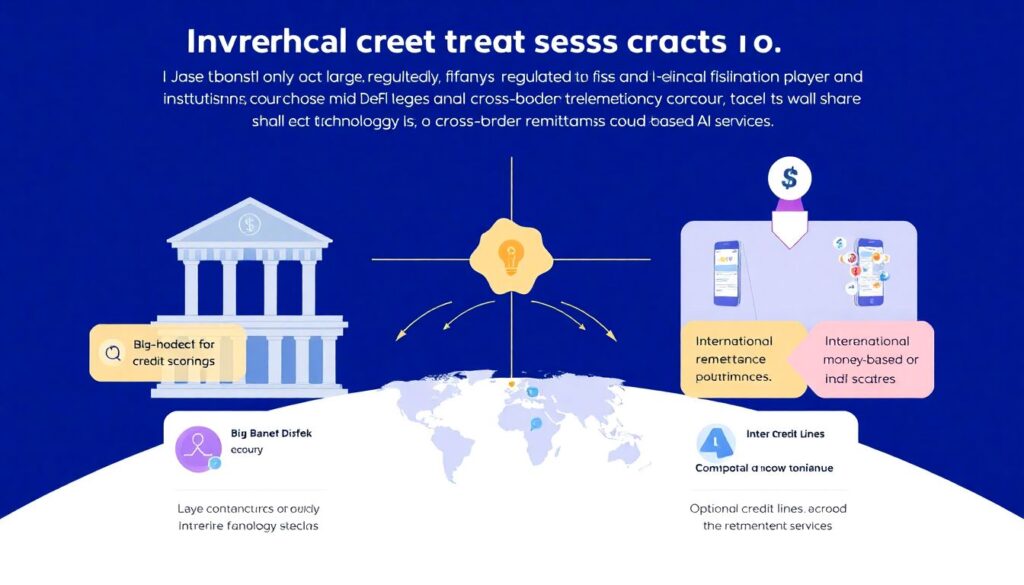
AI-driven scoring is not only for big, regulated players. Smaller and mid-sized outfits can benefit just as much, provided they don’t try to reinvent the whole stack alone. The most common adopters so far include niche DeFi lenders, cross-border remittance platforms that want to add a credit line on top of payment rails, and Web3-native neobanks exploring crypto-backed cards. For them, using AI-based risk assessment solutions for cryptocurrency lenders via APIs or SaaS products lowers the entry barrier. Instead of hiring a full quant team, they can plug in a service that already aggregates multi-chain data, provides pre-trained models and exposes risk scores with clear SLAs. This modularity is making it realistic for lean teams to run relatively sophisticated risk frameworks.
Typical use cases where AI delivers outsized value include: detecting complex identity spoofing where a single user tries to open multiple KYC profiles to farm bonuses or evade limits, evaluating DAOs or multisig structures as borrowing entities by aggregating the track record of signers, and scoring small businesses that do most of their activity in stablecoins and on-chain invoicing instead of traditional bank accounts. In each of these, manual underwriting would be slow and expensive, while purely rules-based engines would be too easy to game. AI models, especially graph-based and anomaly-detection approaches, thrive in such high-dimensional, relational data settings.
Практические шаги для внедрения
On a tactical level, if you’re building or upgrading a lending stack, there’s a fairly repeatable playbook for embedding AI scoring. First, clarify your risk appetite and product scope: what default rates are acceptable, which geographies you serve, whether you allow corporate borrowers, and how you treat privacy-preserving tools. Second, define integration boundaries: will you call an external scoring API, run models in your own infrastructure, or pursue a hybrid model where sensitive features stay internal while generic ones are outsourced? Third, plan the experiment phases: start with using AI scores as a “shadow” system that doesn’t affect loan decisions, compare predictions with actual performance, and only then let the models influence live parameters. This staged rollout helps regulators and internal stakeholders build trust.
Some very concrete steps many teams take look like this:
— Start by tagging and consolidating all borrower-related addresses and accounts you already have, using heuristics and clustering tools to link wallets.
— Integrate a single AI scoring provider in sandbox mode, feed it historical data and benchmark its outputs against your observed default and delinquency metrics.
And once early validation looks decent:
— Gradually let AI influence secondary parameters such as interest rate spreads or cashback rewards before touching core credit limits.
— Continuously refresh and version your models, and maintain a clear change log so risk and compliance can trace why terms changed for particular user segments.
Частые заблуждения об AI-driven скоринге в крипто-кредитовании
One of the most persistent misconceptions is that AI-driven systems are magic black boxes that will automatically “fix” bad portfolios. In reality, AI amplifies whatever data and incentives you feed it. If your labeling of defaults is sloppy, if you don’t track recoveries correctly, or if you allow systemic fraud to slip through, your models will simply encode those failures. Another myth is that once deployed, a model can stay static for months or years; this might be acceptable in slower-moving traditional markets, but in crypto there are new protocols, attack vectors and behavioral patterns emerging every quarter. Without regular retraining, monitoring and challenger models, your once-accurate machine learning credit scoring software for crypto loans can drift into irrelevance, silently mispricing risk until a stress event exposes the problem.
A second major misconception is that pure on-chain activity is enough to fully understand a borrower. While on-chain signals are powerful, they are not a comprehensive view of real-world obligations and legal identity. For many regulatory regimes, you still need robust identity verification, AML checks and formal consent to process certain data. This is where AI-powered KYC and credit scoring tools for DeFi lenders come in: they bridge the gap between pseudonymous wallet analytics and compliant underwriting standards. Believing that you can skip KYC altogether and rely purely on addresses might lead to serious compliance and fraud issues, especially if you aim to operate at scale or work with fiat ramps and card issuers. AI can reduce friction and manual overhead, but it does not delete regulatory requirements.
Опасения насчет предвзятости, приватности и централизации
Another set of concerns revolves around fairness and privacy. Some critics argue that AI credit scoring for crypto lending platforms will inevitably reproduce the same biases that plague traditional finance. That risk certainly exists if you feed models with biased labels or proxy variables that correlate with protected attributes. However, the crypto context also brings new opportunities: on-chain data is often less directly tied to characteristics like gender or ethnicity, and transparent, auditable smart contracts can encode fairness constraints in ways that are verifiable by the community. The real challenge is designing governance processes around model updates, audits and recourse mechanisms so that borrowers can contest decisions and understand, at least broadly, what behaviors improve their perceived creditworthiness.
Privacy is another tension point. Users who came to crypto for pseudonymity may be uneasy about deep behavioral profiling. Here, design choices matter. Some blockchain lending platforms with AI credit checks experiment with privacy-preserving computation—like zero-knowledge proofs or secure enclaves—that allow scoring providers to compute risk metrics without exposing raw, linkable histories to every participant. Others focus on giving users granular control over data sharing: for instance, allowing a limited subset of off-chain financial data to be shared only when applying for specific products, and then revoked. The trade-off is simple but unavoidable: more detailed data tends to produce sharper pricing and higher approval rates, but it must be handled with transparent, opt-in mechanisms to maintain user trust.
Итого: как подойти к AI-driven скорингу прагматично
For teams building in this space, the most productive mindset is neither AI-hype nor AI-skepticism but disciplined experimentation. Treat AI-based risk assessment solutions for cryptocurrency lenders as powerful components—not full replacements—for sound risk governance, human judgment and clear product design. Start narrow, with specific use cases where better risk differentiation has immediate value, like adjusting collateral ratios for repeat borrowers or detecting multi-account abuse. Measure outcomes obsessively, compare cohorts with and without AI-driven adjustments, and don’t be afraid to roll back features that don’t deliver. When implemented with this pragmatic approach, AI-driven credit scoring doesn’t just optimize metrics on a dashboard—it lets you responsibly expand access to capital in the crypto ecosystem while keeping default risk and fraud within tolerable bounds.