
Why AI-on-blockchain apps live or die by data quality
AI-on-blockchain sounds futuristic, but the weak point is painfully mundane: bad data. Over the last three years, most teams have discovered that clever models and fancy smart contracts don’t help if training and inference data on-chain and off-chain is noisy, incomplete or manipulated. Between 2022 and 2024, several surveys from firms like Gartner and IDC estimated that poor data quality was responsible for 20–30% of failed AI pilots; when you narrow that to AI plus blockchain, internal post‑mortems in large enterprises often quote losses in the tens of millions from mispriced DeFi risk models, flawed fraud detection, or compliance breaches triggered by inconsistent on-chain identities and off-chain KYC records. That is why AI-driven data quality assurance moved from “nice-to-have” to architectural requirement.
What “AI-driven data quality assurance” actually means in this stack
When you add AI to blockchain, you inherit problems from both worlds: immutable but messy ledgers and powerful but brittle models. AI-driven data quality assurance layers machine learning and rule-based checks across data ingestion, labeling, training and runtime inference. Instead of static SQL rules or manual dashboards, models continuously learn typical patterns in transactions, oracle feeds and user events, then flag anomalies, missing attributes and suspicious correlations. In practice, this means every pipeline feeding an AI-on-chain agent, a risk-scoring contract or an on-chain recommendation engine is guarded by a learning system that scores datasets before they ever touch model weights, and keeps monitoring drift as new blocks come in.
Key components specific to AI-on-blockchain apps
In traditional ML, you control the data warehouse; in Web3 you often don’t. That forces a different design for data quality tools for ai models on blockchain, because they must cope with pseudonymous actors, multi-chain data, forks, and delayed finality. A modern setup will validate provenance of off-chain sources that are mirrored on-chain through oracles, reconcile multiple chain states when bridges are involved, and maintain feature stores that can reconstruct the exact data slice used by a model at any given block height. AI-driven assurance adds behavioral baselines for wallets and protocols, so if a training dataset starts over-representing wash trading or bot swarms, you see it early rather than after your model has learned those patterns as “normal”.
Recent statistics: where organizations stand in 2025
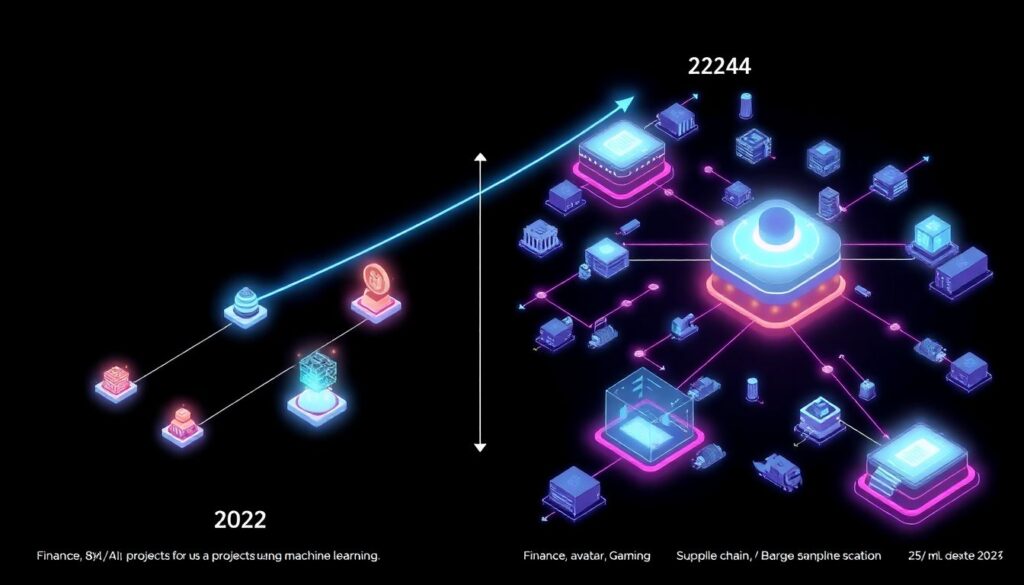
Over 2022–2024, adoption metrics changed sharply. In 2022, most blockchain AI experiments were small; IDC estimated less than 8% of blockchain projects used ML in production. By late 2024, that figure had climbed toward 25–30% for finance, gaming and supply-chain use cases, with a parallel rise in demand for specialized data quality platforms. Spending followed the same trajectory: market estimates for AI data quality tooling across all industries grew from roughly $1.1B in 2022 to about $2.4B in 2024, with blockchain-related deployments still a niche but the fastest-growing segment, averaging annual growth rates above 40% as enterprises tried to tame increasingly complex multi-chain, multi-model architectures.
Error rates and incident data from the last three years
Looking at operational data, incident reports tell an even clearer story. Between 2022 and 2024, crypto risk analytics vendors disclosed that model misclassification rates on uncurated, raw on-chain data could be 2–3 times higher than on curated datasets; fraud-detection false positives in DeFi loan platforms sometimes exceeded 15% when oracle feeds had gaps or timestamp mismatches. After introducing AI-powered data validation for blockchain analytics, several providers publicly claimed drops of 30–50% in false positives and materially lower model retraining frequency, because the underlying data pipelines stopped drifting so quickly. While exact numbers vary, you can safely assume that robust quality assurance cuts both direct losses and engineering toil substantially.
Regulatory pressure as a quantitative driver
Regulation also shows up in the numbers. From 2022 to 2024, the volume of on-chain transactions subject to explicit regulatory reporting—think MiCA in the EU or stablecoin guidance in the US—grew by well over 100%, especially in tokenized assets and on-chain securities. Each of those regimes implicitly assumes you can prove where your data came from and how models made decisions. That has pushed adoption of enterprise ai and blockchain data governance solutions that bundle lineage tracking, consent management and model audit logs with strong data quality checks. Vendors in this niche reported compound annual growth rates in the 35–45% range, outpacing “plain” blockchain infrastructure spends over the same period.
How AI-driven assurance actually works under the hood
Conceptually, an ai data quality platform for blockchain acts as a control plane that sits between raw data sources (nodes, indexers, oracles, data lakes) and your AI models or on-chain agents. It monitors schema conformance, completeness, timeliness, duplication and semantic consistency across billions of on-chain records and associated off-chain context like user profiles or legal documents. Crucially, it does not rely only on fixed rules; it learns statistical profiles of “normal” behavior, builds embeddings of transaction graphs, and uses them to catch new classes of error and abuse that hard-coded checks might miss—such as subtle sandwich bots poisoning training data for a DEX price-prediction model.
ML techniques tailored to blockchain data
To make this concrete, think of two categories of models. First, unsupervised methods: clustering and autoencoders can uncover atypical wallet activity that indicates compromised keys or synthetic liquidity, which should be down-weighted or excluded from training data. Second, supervised models trained on labeled incidents: they can identify patterns associated with oracle manipulation, bridge exploits or NFT wash trading. The AI layer scores incoming records in real time, assigning a quality or trust metric before they hit feature stores. Paired with rule engines that enforce business constraints—like asset coverage, KYC completeness, or jurisdictional checks—you get a robust hybrid defense against bad data creeping into AI-on-chain logic.
Continuous feedback loops with production models
Once models go live, the assurance loop doesn’t stop. Drift detection tracks how distributions of features derived from on-chain events change versus the training baseline. If your lending protocol suddenly sees collateral coming mostly from a new chain with different volatility patterns, or your identity scoring model suddenly ingests a spike of partially verified users from a new jurisdiction, the quality platform flags this. Engineers can then retrain with rebalanced datasets or adjust business thresholds, instead of waiting until loss ratios or fraud cases spike. Over 2023–2024, teams that adopted such closed-loop monitoring reported 20–40% reductions in unplanned “fire drill” retrains.
Economic aspects: costs, savings and new revenue
From a CFO’s perspective, AI-driven data quality assurance looks like extra overhead, but the numbers usually argue in its favor. Historically, data engineering labor has been the hidden tax on AI: surveys around 2023 suggested data teams spent 40–60% of their time cleaning and reconciling data, and for blockchain-heavy stacks that figure often looked worse, given the quirks of RPC endpoints, reorgs and fragmented indexers. By automating a good portion of anomaly detection, schema mapping and reconciliation, managed data quality assurance services for ai applications can cut this manual toil significantly, freeing expensive engineers for higher-value tasks such as model optimization and protocol design.
Risk reduction and avoided losses
The more interesting economics show up in risk-adjusted outcomes. Consider a DeFi protocol that misprices collateral because its risk model ingested a month of corrupted oracle data. Even a modest 2–3% pricing error on tens or hundreds of millions of dollars in loans can erase a year of protocol revenue or permanently damage token value. Insurance for such tail events is either extremely costly or unavailable. Investing a low single-digit percentage of project budget into AI-driven quality controls becomes a form of self-insurance: you are reducing the probability and severity of catastrophic loss. From 2022–2024, several protocols that survived volatile markets with limited exploit exposure explicitly credited better data validation pipelines as a key defensive layer.
Enabling monetization of trusted data
There is also an upside: if you can demonstrate verifiably clean, well-governed data, you can sell it or build premium analytics. High-quality labeled on-chain datasets for credit scoring, ESG reporting or supply-chain provenance trade at a significant markup compared with raw transaction dumps. Platforms that embed strong AI-driven assurance and publish cryptographic proofs of their data curation processes are finding it easier to attract institutional buyers who otherwise distrust on-chain noise. In that sense, data quality is not only a cost center but a differentiator that lets you offer higher-margin “trust as a service” in data marketplaces and B2B analytics products aimed at banks, regulators and large enterprises.
Impact on the broader blockchain and AI industries
The rise of AI-driven data quality tooling is already reshaping industry norms. In the blockchain ecosystem, we are moving from “best effort” indexers and analytics dashboards toward audited, SLA-backed data feeds suitable for safety-critical use cases like tokenized real-world assets, trade finance or on-chain insurance. At the same time, AI practitioners are being forced to treat blockchain not as an exotic data source but as a first-class, high-volume stream that demands specialized governance. Over the past three years, large cloud providers and Web3 infrastructure firms have started partnering or merging with quality-focused startups, consolidating the stack and raising expectations for reliability and observability.
Enterprise adoption and governance culture
Enterprises looking at AI-on-chain pilots increasingly insist on end‑to‑end observability and compliance stories before approving budgets. That shift is pushing vendors to bundle governance controls directly into their quality platforms: data lineage graphs that trace every feature back to a block and transaction, consent tracking for user data that touches both Web2 and Web3, and audit logs that reconstruction model decisions for regulators. As these enterprise ai and blockchain data governance solutions mature, they create a positive feedback loop: better governance reduces incident risk, which encourages more conservative industries—insurance, trade finance, healthcare—to experiment with AI-on-blockchain applications they previously considered too opaque or risky.
Open ecosystems and standardization
On the open-source side, community projects are gradually converging on shared schemas, validation rules and interoperability standards. This matters because AI assurance needs consistent semantics across chains and protocols; otherwise, each project rebuilds its own fragile, bespoke checks. Foundations and industry groups have started to propose standardized metadata for transactions and smart contracts, explicit flags for AI-generated or AI-scored events, and portable quality metrics that can travel with datasets across marketplaces. Over time, this standardization reduces integration friction, multiplying the value of any single quality platform and making it far easier to stitch together multi-chain AI workflows while preserving end‑to‑end trust in the data pipeline.
Practical guidance: how to start implementing AI-driven quality now
If you are planning an AI-on-blockchain app in 2025, you should treat AI-driven assurance as part of the base infrastructure, not an afterthought. Begin by mapping your data flows: which nodes or indexers you depend on, how oracle feeds are sourced, how off-chain data is merged, and where feature stores live. From there, pilot an ai data quality platform for blockchain that can plug into your existing observability stack, exposing model-ready metrics your data and ML engineers already use. Make sure it supports versioned schemas, multi-chain indexing and the ability to replay historical data for forensic analysis; without those capabilities you will struggle to debug subtle model failures several months after deployment.
Choosing and operating tools effectively
The tool choice is only half the story; operational discipline matters just as much. Start by defining explicit quality SLAs: acceptable levels of missing data, latency, drift and anomaly rates for each critical dataset. Configure your quality tooling to measure and alert on those metrics rather than generic “health” indicators. Integrate the alerts with your CI/CD pipelines so a model cannot be promoted if critical quality checks fail on its training data. Treat quality incidents with the same seriousness as security incidents: do blameless post‑mortems, track root causes, and feed that knowledge back into your validation rules and model retraining strategies. Over a few iterations you will notice fewer surprises and more predictable model behavior, even as on-chain conditions shift.
Looking toward the next three years

By 2028, expect AI-driven assurance to be embedded in virtually every serious AI-on-blockchain stack, much like observability and automated testing are today in conventional software. The boundary between “feature engineering” and “data quality” will blur further as models help curate and synthesize training data automatically, while blockchains contribute verifiable lineage and tamper‑evident logs. Teams that invest early will not just avoid painful outages; they will accumulate high-quality, well-governed datasets that become durable competitive assets. If you treat every new piece of data as potentially toxic until it passes intelligent, automated checks, you set your AI-on-chain applications up for resilience in a landscape where both attackers and regulators are becoming significantly more sophisticated.