

Why AI-enabled auditing matters for tokenized assets
When you move real-world value onto a blockchain, mistakes stop being “bugs” and become instant financial losses. That’s why AI-enabled auditing for tokenized asset projects is not just a nice add-on, it’s survival gear. Instead of relying purely on manual checks, you combine human expertise with algorithms that don’t get tired, don’t skip lines, and can continuously watch on-chain behavior. In practice, this means faster feedback loops, fewer blind spots, and a much better chance of catching edge cases before they hit production. For teams shipping fast in competitive markets, this blend of automation and expert review is becoming the default, not the exception.
Key terms you need to get straight
Before diving into workflows, it helps to align on vocabulary. Tokenized assets are digital representations of value (equity, bonds, real estate, in-game items) issued as blockchain tokens with explicit rights and rules. An audit, in this context, goes beyond code review: it includes logic validation, economic modeling, and regulatory checks. AI auditing for tokenized assets means using machine learning, pattern recognition, and automated reasoning to augment traditional audit methods. The goal is not to replace auditors, but to offload repetitive analysis, highlight anomalies, and surface hidden dependencies that humans might overlook.
What “AI auditing for tokenized assets” actually does
When people hear “AI,” they often imagine a black box giving yes/no stamps. In reality, AI auditing for tokenized assets works more like a hyper-focused assistant. It parses smart contracts, transaction histories, and configuration files, then flags inconsistencies and risky patterns. For example, it can detect unusual permission settings, token minting functions that bypass expected checks, or economic parameters that make a pool susceptible to manipulation. Instead of reading thousands of lines of Solidity by hand, the auditor gets a prioritized list of hotspots, along with contextual hints that accelerate manual investigation instead of replacing it.
Text-based diagrams: how AI fits into the audit flow
Think of the audit pipeline as a series of stages where AI plugs in as a co-pilot:
— Inputs:
`Business Specs -> Legal Requirements -> Smart Contracts -> On-chain Data`
— AI Layers:
`Static Code Analysis -> Pattern Matching -> Simulation -> Anomaly Detection`
— Outputs:
`Risk Map -> Issue List -> Severity Scores -> Monitoring Rules`
Visually, as a text diagram:
`Project Idea => [Design Review] => (AI checks assumptions) => [Code Audit] => (AI scans contracts) => [Economic Tests] => (AI runs simulations) => Launch => (AI monitors live data)`.
Each AI block narrows the search space so humans can focus on judgment calls and nuanced trade-offs.
From classic audits to AI-enabled: what really changes
Traditional blockchain audit services for tokenized projects rely heavily on manual code reading, checklists, and static security tools. This works, but it doesn’t scale well when your protocol has dozens of contracts, upgradeable proxies, and complex access control. AI-enhanced approaches add adaptive learning: they digest past incidents, known exploit patterns, and historical project data. Over time, the system becomes better at guessing where the next problem will hide. The biggest shift isn’t just speed; it’s the ability to reassess risk after every deployment or parameter change, something manual-only teams struggle to do consistently.
Where AI adds the most value in practice
In real projects, AI shines in the messy middle: those recurring, detail-heavy tasks that humans find boring. For example, it can automatically map inheritance trees and modifier chains, revealing when a supposedly “simple” token actually depends on many layers of logic. It can cross-check documented supply caps with the actual minting logic and ownership privileges. When used well, it turns ad-hoc, spreadsheet-driven audits into systematic processes with clear coverage metrics. Instead of guessing whether “we’ve looked at enough,” teams can see exactly which contracts, functions, and flows have been stress-tested.
Practical workflow: setting up AI in your audit process
To make AI useful day-to-day, you need a simple, repeatable workflow. First, you integrate static analysis tools that understand your stack (Solidity, Vyper, Move, etc.) and feed their output into AI models trained to classify and prioritize issues. Next, you pipe test results, simulation logs, and even Git history into the same analysis layer. Finally, you connect your CI/CD pipeline so new commits automatically trigger scans. The idea is to treat every pull request as a mini-audit, not wait for a massive review right before launch. This reduces stress, spreads cost over the development cycle, and makes issues cheaper to fix.
Smart contract audit for tokenized asset platforms with AI
In a smart contract audit for tokenized asset platforms, AI tools can go beyond pattern matching. They can infer access control graphs, simulate multi-step attack paths, and compare your implementation against a library of known-safe templates. Practically, that might mean auto-generating scenarios where a malicious admin tries to bypass vesting rules, or where a flash-loan-enabled attacker targets oracle updates. Each simulated outcome feeds back into a risk dashboard. Human auditors then inspect the most critical branches, add business context, and confirm whether the risk is theoretical or exploitable in your specific deployment.
Hands-on examples: how teams actually use this

Consider a tokenized real estate platform planning a mainnet launch. The team connects their repository to an AI audit service that scans contracts on every push. During development, the AI spots that the “emergency withdraw” function allows an operator to bypass a time-lock if a certain flag is misconfigured. It also detects that one role in the access control system can indirectly change valuation parameters in ways not reflected in the docs. These are not obvious bugs; they’re subtle privilege escalations. By surfacing them early, the project fixes design flaws while investors still see a clean audit trail.
AI-powered compliance: staying ahead of regulators
As soon as you deal with securities-like tokens, compliance stops being optional. AI-powered compliance tools for digital asset tokens can read jurisdiction-specific rules, prospectuses, and internal policies, then check them against both code and live behavior. In practice, this might mean ensuring that whitelisting logic enforces KYC/AML constraints, or that transfer restrictions match what your legal team promised in offering documents. Instead of one-time legal reviews, you get continuous alignment: every new feature or parameter update gets scanned for unintended regulatory impacts, dramatically cutting the odds of drifting into non-compliance over time.
Regulatory risk assessment for tokenized assets using AI
The phrase regulatory risk assessment for tokenized assets using AI might sound abstract, but it can be quite concrete. AI models can flag when a token’s behavior starts to look like a security under specific legal tests, or when yield mechanisms resemble regulated investment products. They can correlate your on-chain flows with reporting thresholds, travel rules, and sanctions lists. While they can’t give legal opinions, they do an excellent job at triage: surfacing scenarios that need human legal review right now, and documenting why a particular pattern might be sensitive in one jurisdiction but harmless in another.
Comparing AI-enabled audits to other approaches
Compared to pure manual audits, AI-based approaches offer stronger coverage and faster iteration, but they require more upfront setup and better data hygiene. Compared to fully automated scanners, AI systems handle nuance better and adapt to novel patterns instead of just known signatures. Think of it this way: simple tools can tell you “this line looks like a reentrancy risk,” whereas an AI-augmented pipeline can say “this upgrade path plus this admin role plus this external call create a realistic exploitation chain.” That extra layer of reasoning is what makes the approach compelling for complex, high-value tokenized systems.
Pros and cons in everyday use
In day-to-day work, the trade-offs are clear. You gain richer insights, earlier warnings, and ongoing monitoring, but you must manage model configuration, training data, and false positives. Teams that treat AI like a magic box usually get overwhelmed by noisy alerts. Teams that treat it as a disciplined extension of their security workflow tend to see big benefits: faster audits, better documentation, clearer risk maps. The sweet spot is combining AI output with playbooks, coding standards, and well-defined sign-off processes so that intelligent suggestions translate into concrete, trackable actions.
How human auditors and AI collaborate
Despite the marketing hype, experienced auditors are still central. AI is best used to generate hypotheses: “These functions form a critical path,” “These tokens don’t behave as documented,” “These addresses act like a cartel.” Humans then validate, refine, or discard those hypotheses. Over time, audit teams retrain models with confirmed findings, so future analyses become sharper. Culturally, this shifts auditors away from rote line-by-line reading toward higher-level reasoning: economic security, governance failure modes, and game-theoretic incentives. The result is less manual drudgery and more brainpower spent on the parts that actually require judgment.
Practical tips for integrating AI into your process
To make this work on a real project, start small and iterate:
— Begin with read-only analysis: plug AI into your repo and CI, but keep changes advisory-only.
— Define clear severity categories and escalation rules before you trust AI recommendations.
— Pair each AI finding with a human “owner” responsible for verifying and documenting decisions.
Once the basics run smoothly, you can expand:
— Add on-chain monitoring that watches deployed contracts for anomalies.
— Feed legal and business documentation into the system for richer cross-checking.
— Use the resulting insights to refine coding guidelines and governance policies.
Choosing AI-driven audit and monitoring tools
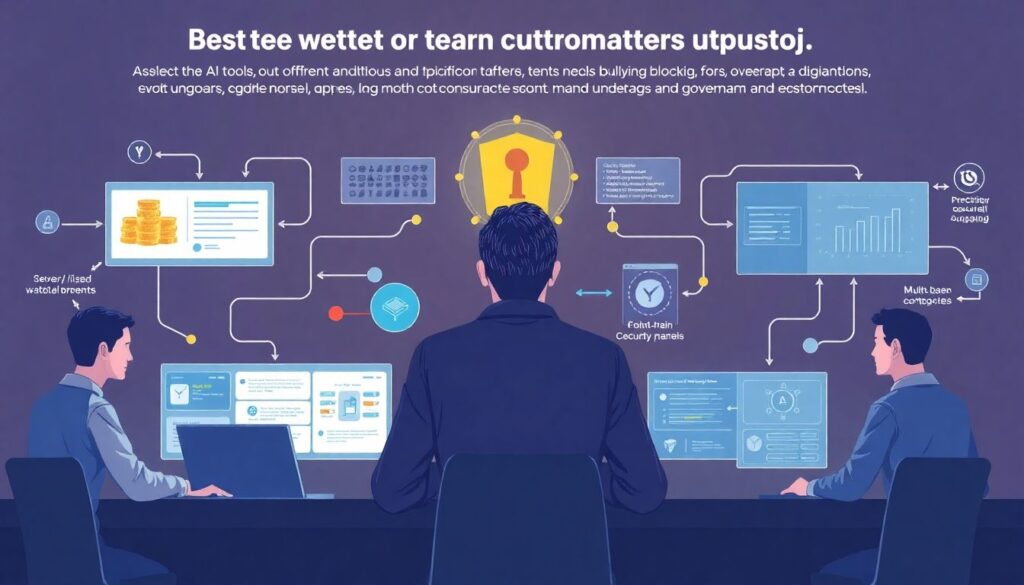
Selecting tools for AI auditing isn’t about picking the “smartest” model; it’s about fit. You want systems that understand your target chains, languages, upgrade patterns, and governance models. For teams with complex tokenized treasuries, strong support for multi-sig, role-based access, and cross-chain bridges is essential. You’ll also want transparent explanations: every flagged issue should show why it was raised and which data points drove the conclusion. Without explainability, engineers won’t trust the alerts, and the whole exercise degenerates into ignored dashboards and stale reports instead of actionable insight.
How modern blockchain audit services for tokenized projects look
Modern blockchain audit services for tokenized projects increasingly bundle AI analytics, human review, and ongoing monitoring into a continuous engagement rather than a single “pass/fail” report. Instead of one PDF before launch, you get a living risk log, periodic re-scans after upgrades, and clear triggers for re-audit when parameters change. Service providers use your anonymized incident history and their multi-client dataset to improve the AI engine. In turn, you benefit from patterns learned across the broader ecosystem—breach attempts, governance failures, and emerging attack strategies—without exposing your proprietary details.
Getting started on your own project
If you’re building a tokenized asset platform today, treat AI as a core part of your security and compliance stack from day one. Wire up repositories to automated scanners, feed results into AI-based triage, and put humans in the loop for decisions. Keep your documentation, legal analysis, and threat models in a form that machines can parse—structured specs, machine-readable roles, clear parameter definitions. The more consistent your inputs, the better your AI outcomes. Over a few release cycles, you’ll move from occasional audits to a continuous, AI-augmented assurance pipeline that matches the speed and complexity of modern tokenized finance.