
AI‑driven smart cities: where urban planning meets code
Why AI and ledgers suddenly matter so much for cities
Over the last five years, mayors and city CTOs have quietly shifted from pilots to production‑grade smart city infrastructure solutions. Traffic lights, street lighting, water pumps and even parking meters are now data sources for machine‑learning models that continuously optimise flows in real time. At the same time, the trust problem has become obvious: residents want transparency about how data is used, regulators demand auditability, and operators need secure coordination between hundreds of vendors. That is why distributed ledger technology for smart cities has moved from “blockchain hype” to a practical tool for logging transactions, access rights and service‑level commitments. The combination of AI for decision‑making and ledgers for verifiable coordination is turning city infrastructure into something closer to a digital platform than a static utility network.
Key architectural building blocks in 2025
Modern deployments rarely look like monolithic “smart city platforms” from glossy brochures a decade ago. Instead, cities are building layered architectures where edge devices handle sensing and low‑latency control, regional hubs perform aggregation, and cloud environments run heavy analytics and long‑term modelling. On top of that runs an ai powered smart city platform that orchestrates data pipelines, model lifecycle management, identity services and integration with legacy SCADA systems. Distributed ledgers sit alongside, not underneath, this stack: they provide tamper‑evident logs of device onboarding, firmware updates, micro‑payments for energy or mobility, and cross‑agency workflows. This modularity lets cities swap subsystems without rebuilding everything, while still maintaining a unified security and governance layer that can survive vendor turnover and political cycles.
Data, AI and the rise of autonomous urban operations
From dashboards to self‑optimising infrastructure
The early wave of smart city projects was essentially “dashboards for mayors”: lots of nice graphs, limited operational impact. In 2025 the centre of gravity has shifted to autonomous control loops. Smart city IoT and AI integration now means sensors feeding reinforcement‑learning agents that tweak signal timing, adjust district heating temperatures or reroute electric buses every few seconds. For example, European pilots have shown 15–25% reductions in congestion on key corridors when AI manages adaptive traffic signals using multi‑modal data. Similar gains are emerging in power distribution, where AI forecasts rooftop solar output and EV charging demand at the feeder level, giving grid operators hours of warning to balance loads. The human‑in‑the‑loop role does not disappear; it moves to supervising policies, safety thresholds and exceptions instead of micromanaging everyday operations.
Why ledgers are becoming the “black box recorder” of the city
As AI gains autonomy, the questions “who changed what, when, and under which policy?” become existential. This is where blockchain smart city services have a very specific and non‑glamorous job: persistent, append‑only registries. When a model is updated, a threshold is altered, or a device is reconfigured remotely, a hash of the configuration, identity metadata and authorisation proof can be anchored in a consortium ledger shared by utilities, regulators and sometimes citizen auditors. In case of an incident, investigators can reconstruct the exact state of the system at a given moment without relying on a single vendor’s logs. This does not mean that every sensor reading lands on‑chain; instead, ledgers store compact proofs and references, while bulk data stays in cheaper object stores, combining legal traceability with operational scalability.
Statistical signals: what the numbers say
Adoption and investment trends as of the mid‑2020s
Global smart‑city technology spending has been growing in the high single digits annually and is on track to exceed 500 billion USD around the middle of the decade, with AI‑enabled use cases accounting for a steadily rising share of that budget. Industry surveys indicate that more than half of large cities in OECD countries now operate at least one production AI system for mobility, energy or public safety, beyond simple analytics. Meanwhile, distributed‑ledger‑based pilots remain fewer in absolute number but are concentrated in high‑value workflows like carbon accounting, mobility payments and inter‑utility data sharing. Analysts expect blockchain‑related urban infrastructure spending, still in the single‑digit billions, to multiply several‑fold by 2030 as standards mature and interoperability with existing IT systems improves. The overall trajectory points toward AI as the immediate driver, with ledgers following as trust infrastructure.
Quantifying efficiency and sustainability gains
Where cities have deployed coordinated AI and sensor networks at scale, certain performance ranges are becoming visible across regions. Adaptive traffic management systems routinely report double‑digit reductions in average travel time on optimised corridors, along with proportional drops in tailpipe emissions. Smart metering and demand‑response programs, powered by predictive models, can trim peak electricity loads by around 5–10% in participating districts, delaying the need for costly grid reinforcements. Waste‑collection routes optimised using fill‑level sensors and path‑finding algorithms often reduce fleet mileage by a similar order of magnitude. These percentages may sound modest, but applied to multi‑billion‑dollar urban budgets they translate into substantial recurrent savings and lower environmental footprints. Over the long term, such compound improvements can free up fiscal space for social programs, public transit expansion or further digital‑infrastructure upgrades.
Economic logic behind AI‑ and ledger‑enabled cities
Cost structures, ROI and new revenue channels
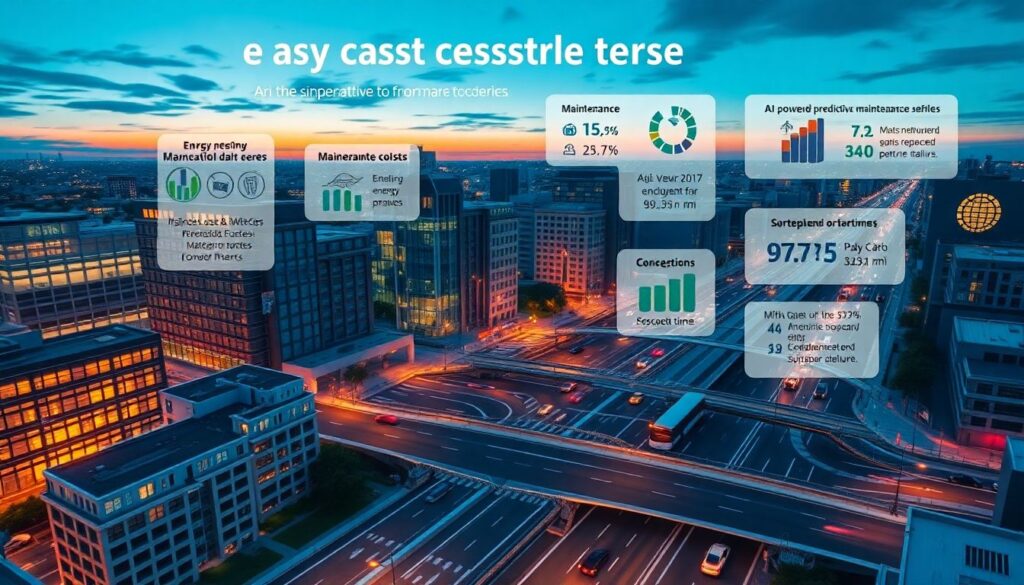
The business case for AI in infrastructure is shifting from speculative to measurable. Cities that push beyond pilots typically report faster payback in areas with clear operational costs: energy, maintenance and congestion. Predictive maintenance on water networks, for instance, can detect anomalies before pipes burst, reducing non‑revenue water loss and emergency repair expenses. Similar logic applies to roads, bridges and rolling stock monitored through computer‑vision and vibration analytics. On the revenue side, dynamic pricing for parking or congestion zones, powered by real‑time models, enables fine‑grained monetisation without blunt across‑the‑board hikes. When tokenised payments and usage rights are settled via blockchain smart city services, micro‑transactions become economically viable: think per‑kilometre road usage fees for autonomous shuttles or granular billing for flexible workspace in municipal buildings. These mechanisms gradually rewire how cities fund and operate their assets.
Tokenised infrastructure and marketplace dynamics
As ledgers mature, a more radical economic pattern is emerging: pieces of infrastructure start to behave like participants in a marketplace. A lamppost equipped with EV charging, 5G small cells and environmental sensors can expose its capabilities via APIs, register them in a shared ledger, and receive automated payments as services are consumed. Over time this enables fractional ownership and innovative public‑private partnerships, where citizens, co‑ops or pension funds can finance specific assets and receive yield tied to usage, with revenue flows enforced automatically by smart contracts. While regulation is still catching up, this infrastructure‑as‑an‑asset‑class concept attracts institutional investors searching for long‑duration, inflation‑linked returns. If realised at scale, it could ease municipal balance‑sheet constraints and accelerate deployment of critical digital and green systems without relying solely on tax increases or central‑government transfers.
Industry impact and shifting value chains
How vendors, utilities and startups are being reshaped
Traditional engineering firms that once delivered turnkey hardware are increasingly forced to behave like software companies. They must expose open interfaces, plug into an ai powered smart city platform chosen by the municipality, and commit to data‑sharing standards rather than closed ecosystems. Utilities, for their part, are learning to operate as data‑driven service providers, bundling energy, connectivity and analytics. Startups occupy the gaps by offering AI‑based optimisation modules, privacy‑preserving data‑sharing solutions and domain‑specific ledgers tailored to mobility or real‑estate registries. As contracts become outcome‑based, with SLAs tied to performance metrics logged immutably, integrators able to manage risk and orchestrate heterogeneous players gain negotiating power. This is gradually moving value away from pure hardware margins toward software, governance and lifecycle‑management expertise.
Regulatory, ethical and workforce consequences
The diffusion of AI‑centric urban systems is forcing regulators to define clear guardrails on surveillance, algorithmic bias and vendor lock‑in. Citizens rightly worry that ubiquitous sensors and predictive policing tools could drift into overreach if unchecked. In response, some jurisdictions now require algorithmic impact assessments, explainability audits and open publication of non‑sensitive performance indicators, sometimes anchored through distributed ledger technology for smart cities to ensure they cannot be quietly altered. On the workforce side, routine operational roles in control rooms are declining, while demand surges for data engineers, cybersecurity specialists and domain experts able to interpret model outputs. Educational pipelines, from vocational programmes to urban‑planning curricula, are starting to reflect this shift, blending classical civil‑engineering concepts with statistics, software architecture and digital ethics.
Future trajectories: from connected infrastructure to urban intelligence
Forecasts for the next decade

Looking toward the 2030 horizon, most credible forecasts suggest that AI will be embedded in nearly every layer of urban systems, from storm‑water management to cultural‑event planning. Compute at the edge will keep getting cheaper, pushing more inference directly into substations, traffic cabinets and building‑management systems. At the same time, interoperability stacks will mature, so that smart city infrastructure solutions in different regions can exchange data and services securely instead of remaining isolated pilots. Ledgers are likely to settle into a pragmatic role underpinning identity, entitlements and high‑value transactions, rather than replacing entire databases. If cities manage to align this technological evolution with robust governance and citizen oversight, the result will be less about flashy gadgets and more about quiet reliability: shorter outages, cleaner air, smoother commutes and public budgets that stretch further without sacrificing trust.