
Why anomaly detection in financial networks suddenly got interesting
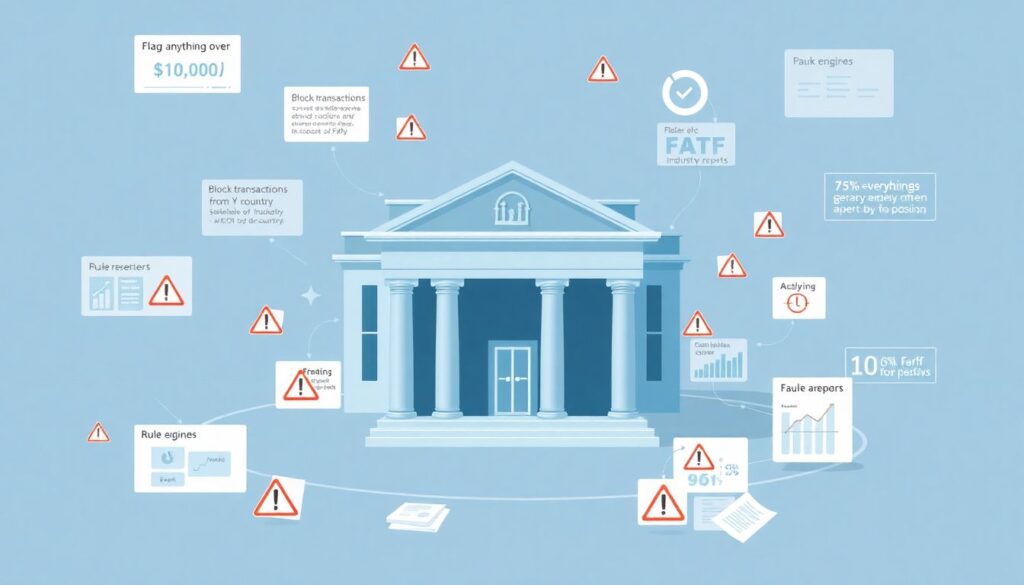
For years, banks hunted fraud and money laundering with rule engines: “flag anything over $10,000”, “block transactions from X to Y country”, and so on. It sort of worked, but at a painful cost: up to 95% of alerts in some large banks turned out to be false positives, according to FATF and industry surveys, and investigators spent hours closing obviously benign cases. Once payments went instant and cross‑border routing became more tangled, these rules simply stopped keeping up. AI-enabled anomaly detection flipped the logic: instead of enumerating every suspicious pattern, models learn what “normal” behavior looks like for each customer, counterparty and network segment, and then highlight subtle deviations. That’s why serious institutions now treat this as core infrastructure, not a side experiment from the innovation lab.
A nice side effect: fewer random blocks of legitimate transactions and less frustration for high-value clients who hate being asked, “Can you explain this payment?” every other week.
—
“`text
Technical note: anomaly detection basics
Most systems mix supervised and unsupervised learning.
• Supervised models: learn from labeled fraud / AML cases; great for patterns you’ve already seen.
• Unsupervised models: cluster similar behaviors and score outliers without labels; crucial for new schemes.
• Semi-supervised: learn “normal-only” profiles, then treat deviations as anomalies.
Under the hood you’ll often see gradient boosting, autoencoders, graph neural networks, and sequence models (e.g., LSTMs, Transformers) combined in an ensemble rather than a single “magic” algorithm.
“`
From blacklists to behavioral fingerprints
A modern ai fraud detection software for banks doesn’t start with lists of bad accounts; it starts with behavior. Instead of saying “transactions to crypto exchanges are risky”, it asks: “Is this crypto transfer consistent with this customer’s past?” A corporate client that regularly moves $1M to a well-known exchange after payroll might be low risk, while a sleepy retail account suddenly wiring $40k through three new intermediaries at 2 a.m. is a different story. By generating a behavioral fingerprint for each entity—merchant, device, card, beneficiary—the system compares each new event against millions of prior patterns. The magic is that the AI does this without requiring an analyst to explicitly code new rules every time criminals shift tactics or exploit a fresh corridor.
This behavioral angle also reduces the classic “thin file” problem: even with a short history, AI can compare you to similar peers and still estimate what’s normal.
—
“`text
Technical note: feature engineering in financial networks
Typical feature groups:
– Transactional: frequency, amounts, currencies, time-of-day cycles, merchant categories.
– Relational: graph-based metrics (degree, PageRank-like centrality, community membership).
– Temporal: short- vs long-term moving averages, volatility, bursts.
– Channel / device: IP history, device fingerprint, geolocation drift.
Large banks easily compute >1,000 features per entity or transaction, updated in near real time. Feature stores and streaming engines (e.g., Kafka + Flink/Spark) are now standard plumbing.
“`
Real-time transaction monitoring without drowning in noise
Instant payments and open banking APIs forced a shift toward real-time decisioning. A real-time transaction monitoring ai platform in a Tier‑1 bank must score thousands of events per second with end‑to‑end latency under 50–100 ms, otherwise user experience collapses. One European bank I worked with processed about 8,000 card transactions per second at peak; their initial rules engine threw alerts on roughly 1.2% of traffic. After introducing a layered anomaly model, they cut alert volume by 40% while catching 25% more confirmed fraud in the first six months. That’s the key: not more alerts, but better alerts. Investigators got prioritized queues, sorted by model confidence and potential loss, so they could focus on the top 5–10% of high-risk cases instead of swimming in a sea of yellow flags.
Speed matters not only for blocking fraud, but also for selectively stepping up authentication in digital channels without annoying everyone else.
A useful design principle: score everything in real time, but only interrupt the customer journey when the risk crosses a dynamic threshold calibrated to loss appetite and operational capacity.
—
“`text
Technical note: architecture of real-time scoring
Common pattern:
1) Transaction hits gateway / API.
2) Streaming layer enriches it with recent history and network features.
3) Feature vector flows to a low-latency model server (often using ONNX, TensorRT, or custom gRPC).
4) Model returns risk score + top factors.
5) Decision engine maps score to actions: approve, decline, hold, or step-up (OTP, call, manual review).
Total added latency must stay below network / UX tolerance, so heavy models are often distilled into smaller ones for real-time use.
“`
Graph-based anomaly detection: following the money properly
machine learning anomaly detection solutions for financial institutions become truly powerful when they stop treating transactions as isolated rows and instead look at the network: who sends money to whom, through which intermediaries, and with what timing. Graph analytics and graph neural networks have become central to advanced AML programs and complex fraud investigations. For example, a Canadian bank used network clustering to detect an apparently legitimate remittance business that was quietly acting as a funnel for dozens of mule accounts. No single transaction looked outrageous, and conventional thresholds didn’t trigger. But when the AI examined the structure—highly asymmetric flows, short-lived nodes, multi-hop routing through the same small set of foreign beneficiaries—the pattern lit up as a structural anomaly. That case alone led to freezing several million USD-equivalent and triggering law enforcement referrals.
Graph views are especially effective against “smurfing”, where criminals break a large flow into hundreds of small payments to slip under fixed thresholds.
—
“`text
Technical note: graph anomaly techniques
Typical techniques include:
– Community detection to spot tightly-knit, high-traffic clusters.
– Subgraph pattern mining to find transaction chains matching risk templates (e.g., rapid layer-and-disperse).
– GNNs (GraphSAGE, GAT) producing embeddings for accounts / merchants; anomalies are outliers in embedding space.
– Dynamic graphs to track how structures evolve over time, not just static snapshots.
“`
From single-use tools to enterprise risk analytics
Once anomaly detection starts proving its worth in fraud or AML, executives quickly ask, “What else can we plug into this?” That’s where enterprise ai risk analytics for financial services comes in. The same core stack—data lake, streaming engine, model serving, explainability tools—can score not only transactions, but also credit exposures, liquidity movements, even trader behavior. One Asian bank re-used its anti-fraud infrastructure to monitor intraday liquidity, feeding anomalies directly into its treasury dashboard. Another large European institution connected front-office trading logs, voice transcripts, and communication metadata to flag unusual combinations of orders and chats, supporting conduct surveillance. Economically, this reuse matters: instead of building five silos, they operate one analytics backbone and layer use cases on top, cutting infrastructure spend by double-digit percentages over three years.
The catch: governance has to keep up. Model risk, privacy constraints, and regulatory expectations differ between fraud, credit, and market risk.
—
“`text
Technical note: model governance essentials
Regulators expect:
– Clear documentation of model purpose, data, and limitations.
– Backtesting and stability monitoring (population drift, performance decay).
– Human-readable explanations for high-impact decisions.
– Independent validation teams and periodic re-approval.
Many institutions adopt MLOps stacks with automated monitoring for AUC/precision-recall, PSI (population stability index), and bias metrics across customer segments.
“`
AI-powered AML: from checkbox compliance to intelligence function
ai-powered anti money laundering aml software is where anomaly detection arguably delivers the biggest conceptual shift. Traditional AML often looked like “compliance hygiene”: tick the boxes, run the screenings, send SARs. Yet the UN Office on Drugs and Crime still estimates that less than 1% of global illicit financial flows are seized. AI changes the odds by surfacing hidden networks, unusual layering patterns, and cross-border behaviors that static rules never capture. A global bank piloting an AI-driven AML system reported a 20–30% uplift in “true positive” cases while reducing analyst workload per case by around 35%. They did this by combining entity resolution, network scoring, and NLP on unstructured data like payment references and KYC documents. The point isn’t just more SARs; it’s fewer low-quality reports and more cases that law enforcement can actually act on.
Investigators also get richer context: instead of a single highlighted transaction, they see a story—who is connected to whom, over what period, and how this cluster differs from similar peer groups.
—
“`text
Technical note: explainability and investigator UX
Key UX elements:
– Case view aggregating related alerts into one investigation object.
– Visual network graphs with color-coded risk attributes.
– Natural language summaries (“This account shows a sudden 4x increase in cross-border flows via new high-risk counterparties over 10 days.”).
– Drill-down into top features shaping the score, using SHAP / LIME or custom attribution.
Explainability is not only for regulators; it directly affects investigator productivity and trust in the models.
“`
Where to start if you’re not a Tier‑1 bank

Smaller institutions often assume that sophisticated anomaly detection is out of reach, but the market has changed. Cloud-native vendors now offer machine learning anomaly detection solutions for financial institutions as modular services: you can start with just card fraud or just incoming wire monitoring, then expand. A regional bank with under one million customers typically begins by feeding 6–12 months of historical transactions to a vendor platform, tuning thresholds and alert labels together, and then rolling into production in 3–6 months. Realistically, the hardest part is rarely the model; it’s data plumbing, access rights, and integrating with case management. A pragmatic path is to run AI side-by-side with existing rules, compare performance for a few quarters, and decommission only those rules that clearly add noise but no new detections.
Organizationally, you need a small cross‑functional crew: risk, compliance, IT, and at least one data-savvy product owner who can translate between them.
—
What “good” looks like after deployment
After the initial hype, success is surprisingly measurable. For fraud, many banks target at least a 10–20% reduction in false positives within the first year, without any drop in detection rate; top performers hit 30–40%. For AML, improvements are often framed as an increase in conversion: more of the alerts leading to meaningful cases and SARs. With a mature AI stack and a disciplined feedback loop from investigators back into model training, a real-time transaction monitoring ai platform can continuously adapt to new schemes—card testing bots today, synthetic IDs tomorrow—without a full rebuild. The financial upside is clear: fewer losses, lower operational cost per case, and a smoother customer journey. The strategic upside is subtler but just as important: your risk functions stop reacting to yesterday’s patterns and begin acting like an intelligence unit scanning the financial network in near real time.
If that’s the direction you want, anomaly detection is less a point solution and more the nervous system of your financial data—quietly watching, learning, and nudging humans to look where it really matters.