
Why bring AI into DeFi audits at all
If you’ve ever tried to audit a non‑trivial DeFi protocol by hand, you know the grind: thousands of lines of Solidity, tricky math around liquidity and collateral, and edge cases that only show up under weird on‑chain conditions. AI‑assisted auditing doesn’t replace humans, but it lets you move faster, miss fewer things, and focus your brainpower on actual design flaws instead of boilerplate checks. Think of it as moving from “grep and eyeballing” to a layered workflow where language models, static analyzers, and on‑chain simulators work together. The key is to treat AI as a helper that you direct deliberately: you still define the threat model, choose the tools, interpret the output, and decide what’s safe to ship. Used this way, it becomes a practical multiplier, not a magic black box.
In practice, the stack you build around AI matters more than any single tool.
Prepping your environment and getting the right tools

Before diving into an ai powered defi security audit, you want a clean, reproducible setup. At minimum, you’ll need a recent Node.js environment, a Solidity toolchain (Hardhat or Foundry), and access to one or two serious automated smart contract auditing tools that can plug into your CI. Add a language‑model interface (API or local LLM) that you can script around, a transaction simulator like Tenderly, and a block explorer API for quickly pulling historical state. For teams that don’t want to assemble everything themselves, many defi smart contract audit services now bundle AI‑driven analysis with traditional manual review, but you can assemble a similar pipeline in‑house if you’re comfortable with DevOps and security engineering. Make sure you store all configs in version control so audit runs are traceable and repeatable.
You don’t need a huge budget, but you do need discipline and a few well‑chosen components.
Code access and documentation you actually need
AI can’t meaningfully assist if it only sees fragments of your system. Pull in the full repo: contracts, deployment scripts, configuration, and any off‑chain components that touch privileged functions or price feeds. Good documentation (even rough but honest) about your protocol’s business logic, risk assumptions, and invariants will dramatically improve the quality of AI prompts and the relevance of detected issues. If your docs are thin, it’s worth spending a few hours with the core devs to capture key flows—minting, liquidation, fee routing, governance upgrades—before you unleash automated scanners. That context becomes your ground truth when interpreting what the tools spit out later.
Treat missing documentation as a red flag, not a minor inconvenience.
A layered, step‑by‑step AI‑assisted audit workflow
Let’s walk through a practical process you can apply to most DeFi projects, from AMMs to lending markets. The idea is to alternate between broad automated sweeps and focused, human‑driven reasoning where AI is acting as a copilot. You can use this same flow whether you’re an internal security engineer or someone planning to hire defi security auditor support from outside. Start with reconnaissance: identify contract entry points, admin roles, upgradeability patterns, and external integrations. Then move into static analysis and property checking, followed by dynamic tests and simulations of realistic attacker behavior. Each phase feeds findings into the next, and you keep a living threat log that’s updated as new issues and mitigations are discovered. The result is not just a list of bugs, but a map of how your system fails under pressure.
That map is what stakeholders actually need when deciding if a protocol is ready for mainnet.
Phase 1: Threat modeling with AI as a sounding board
Begin by writing down your threat model in plain language: what your protocol is supposed to do, what must never happen, which funds are at risk, and who could plausibly attack you. Feed that into your language model and ask it to enumerate potential attack surfaces: reentrancy, price oracle manipulation, governance capture, interest‑rate misconfigurations, and so on. You’re not asking for a final verdict; you’re using AI to shake loose scenarios you might overlook. Cross‑check those against famous DeFi exploits and adapt them to your architecture. This is also where you identify critical invariants like “total deposits ≥ total withdrawals” or “system can’t create unbacked tokens.” Later, you’ll codify some of these as tests or formal properties.
Don’t rush this step; a weak threat model makes every later phase less useful.
Phase 2: Static analysis plus AI‑driven triage
Next, run your static analyzers: Slither, Mythril, or whatever stack you prefer. Most teams fire these once and then drown in false positives. Instead, combine them with AI‑driven summarization. Export the findings, group them by contract and severity, and feed batches to your model with the source code. Ask it to explain why a particular alert might be exploitable, how an attacker would profit, and whether existing modifiers or checks already mitigate it. Because models are good at pattern matching text with context, they can quickly reduce a hundred low‑value warnings to a short list that deserves human eyes. You still verify everything yourself, but you’re not wasting an afternoon on irrelevant gas optimization suggestions.
Use this triage loop whenever your tool versions change, or the contracts get significant refactors.
Phase 3: Test generation and invariant checking
Here’s where AI becomes a surprisingly effective junior engineer. Take your existing unit and integration tests and ask your model to propose additional edge cases based on the threat model and contract interfaces. For example, have it generate tests that simulate rapidly fluctuating collateral values, partial liquidations at boundary ratios, or governance proposals queued but never executed. You can even feed in a property‑based testing framework snippet and let the model suggest invariants that must always hold. This doesn’t replace formal verification, but it extends test coverage in places devs don’t usually think about. Combine these with fuzzing so that weird parameter combinations get explored automatically.
Every new class of test you add is one more safety net against unknown unknowns.
Phase 4: Dynamic simulation of attacks
DeFi is all about state and timing, so you need to see how the system behaves over many blocks and under manipulated conditions. Use forking testnets or services like Tenderly to replay real‑world scenarios: thin liquidity, oracle delays, sudden TVL spikes. Feed observed weird behaviors into your AI assistant and ask it to suggest exploit paths or missing checks. It’s especially useful for piecing together multi‑transaction attacks—flash loans plus governance plus collateral withdrawals, for example—because models can narrate step‑by‑step execution based on event logs and traces. You then translate those narrative attack paths back into hard tests or manual PoCs you can run again and again.
This loop turns vague “could this be abused?” worries into concrete sequences you can either block or accept as low risk.
Working with external auditors and security firms
Even if you’re building strong internal capacity, there’s real value in pairing AI workflows with an experienced blockchain security firm for defi protocols that has seen dozens of edge cases in the wild. When you bring them in, don’t just throw over a repo; share your AI‑generated threat model, triaged issue lists, and interesting simulations. This lets external auditors skip the basics and spend more time on architectural flaws and game‑theoretic risks. Many established defi smart contract audit services are themselves layering AI into their process, so you can align your internal pipeline with how they work. That means faster onboarding, less duplicated effort, and a clearer shared view of what “secure enough for mainnet” should look like.
Think of these firms as force multipliers, not replacements, for your own structured analysis.
When and how to “hire a DeFi security auditor”
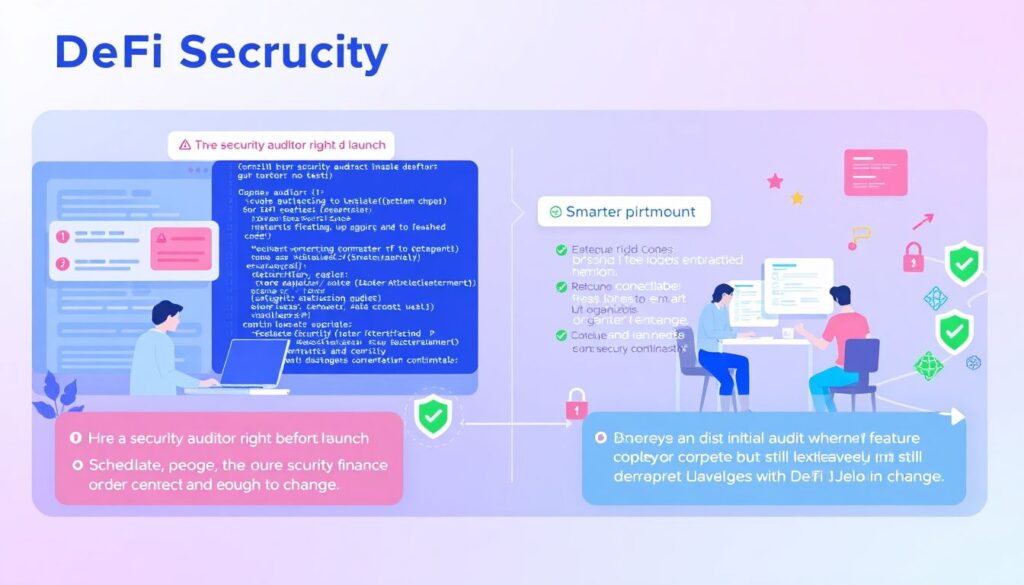
There’s no perfect time to hire defi security auditor help, but there are bad times: right before launch, with unstable code and no tests. A smarter approach is to schedule an initial review when your core logic is feature‑complete but still flexible enough to change. By then, you’ll have already run your internal AI‑assisted pipeline, cut down noise, and fixed obvious bugs. Share not only your findings but also the prompts and scripts you used, so auditors can reproduce or extend your AI flows. After their first pass, incorporate their feedback back into your tooling, updating prompts and checklists. Over a couple of releases, you end up with an audit‑ready codebase and a repeatable system rather than scrambling from one last‑minute engagement to the next.
Auditors appreciate teams that show this kind of maturity; it leads to deeper, more honest reports.
Troubleshooting common AI‑assisted audit problems
AI doesn’t magically remove friction; it trades old problems for new ones. A recurring issue is hallucinations: models confidently inventing vulnerabilities that don’t exist or missing subtle economic attacks because the prompt lacked protocol context. To counter this, always anchor AI opinions in concrete artifacts—specific code snippets, traces, or transaction logs—and insist on a hypothetical attack narrative: “Walk me through the exact calls an attacker makes and when they profit.” If the story falls apart under minimal scrutiny, you mark it as low‑value noise. Another common snag is tool fatigue, where different automated smart contract auditing tools produce conflicting signals. Here, establish a small “source of truth” set and calibrate the rest against it instead of chasing every alert.
In short, make the model prove its claims with reproducible steps, not vibes.
Dealing with false positives, gaps, and model limits
Expect a learning curve. Early on, you’ll over‑trust AI and under‑document your reasoning. Fix that by keeping an audit log where every AI suggestion is tagged as confirmed issue, dismissed, or needs more evidence, ideally with short human comments. Over time, refine your prompts: be explicit about the attack surface, the assumptions you allow, and the severity scale you care about. When you hit something that clearly exceeds the model’s capability (complex interest‑rate models, novel AMM formulas), fall back on math, manual derivations, and peer review. Treat the AI as a very fast but occasionally confused colleague, and you’ll get the benefits—speed, breadth, fresh angles—without drifting into blind trust. That balance is where AI‑assisted DeFi auditing really pays off in practice.