
Monetary policy in tokenized ecosystems has gone from a wild experiment to something that increasingly похожа на инженерную дисциплину. Over just the last three years, builders went from “let’s print a token and see what happens” to deliberate design of supply schedules, feedback loops and governance. Let’s walk through how this evolution unfolded, what the numbers say, and what it means if you’re designing a crypto economy in 2025.
—
From simple supply caps to programmable monetary policy
In early crypto, “monetary policy” mostly meant a fixed cap like Bitcoin’s 21 million and a simple halving schedule. As tokenized ecosystems matured – especially DeFi, gaming and real‑world asset (RWA) platforms – teams started treating token policy as a core part of system design rather than a cosmetic parameter. Today we see dynamic emission curves, on‑chain interest rates, bonding curves and protocol‑controlled treasuries that react to market data. Instead of copying Bitcoin or Ethereum, projects actively simulate how incentives and inflation will shape user behavior, liquidity depth and long‑term sustainability of their networks.
—
Key data from 2022–2024: what actually changed
Over the last three years, the numbers around tokenized systems have shifted in ways that directly reflect this maturing approach to monetary policy. According to DeFiLlama, total value locked in DeFi dropped from over $100 billion in late 2021 to around $40–50 billion in mid‑2022, then gradually recovered to the $75–90 billion range through late 2024, with some spikes above that during market rallies. This crash‑and‑rebuild phase forced protocols to redesign reward schedules, cut unsustainable inflation, and experiment with revenue‑sharing models instead of pure token emissions.
Stablecoins provide another lens. After peaking near $180 billion in circulating supply in early 2022, aggregate stablecoin market cap fell to roughly $120–125 billion by Q1 2023 as speculative demand washed out and regulators tightened oversight. Yet from mid‑2023 to late 2024, the sector stabilized around $130–150 billion, with on‑chain volumes staying high. A larger share of that market came from fully or over‑collateralized designs, while purely algorithmic stablecoins shrank dramatically after the 2022 collapses, pushing designers toward more conservative risk and monetary frameworks.
Real‑world‑asset tokenization is where the most visible growth happened. Tokenized U.S. Treasuries went from well under $200 million outstanding in early 2022 to passing $1 billion in 2024, according to trackers like rwa.xyz, as higher interest rates made on‑chain T‑bill products appealing for both DeFi natives and institutions. At the same time, several large asset managers started pilot programs for tokenized funds and private credit, signalling that predictable, rule‑based monetary policy and transparency of cash flows are becoming table stakes for large‑scale tokenization initiatives.
—
Why token economies need real monetary engineering
In a tokenized system, your token is not just “points on a scoreboard”; it’s the plumbing for value, coordination and risk. Inflation, deflation, and reward schedules shape how quickly users join, how long they stick around, and whether the system can survive a downturn. The last cycle showed that aggressive emissions can attract liquidity but also create brutal reflexivity when token prices fall, causing TVL and user counts to vanish. Sustainable growth requires monetary policy that internalizes these failure modes instead of fighting them with more subsidies.
For founders asking how to create monetary policy for tokenized ecosystems that doesn’t implode under stress, the starting point is to specify economic roles of the token: Is it a pure governance asset, a work token (paying validators or contributors), a medium of exchange in a game or marketplace, or a claim on protocol cash flows? Once those roles are explicit, you can map demand drivers, possible sinks, and realistic revenue sources. That mapping forces clarity on what level of inflation is justifiable and which incentives should be short‑term bootstrapping tools versus permanent features of the protocol.
—
Practical design levers for 2025‑era tokenomics
Modern projects increasingly treat monetary design as a set of configurable levers rather than a one‑time guess. They iterate parameters on‑chain, with community involvement, instead of locking themselves into rigid schedules. This shift favors architectures where issuance rates, staking rewards and fee distributions are upgradable through governance, but bound by clear policies to prevent arbitrary dilution. The goal is to create an adaptive system that can tighten or loosen monetary conditions in response to metrics like utilization, revenue and market volatility, without relying on centralized discretion.
Some of the most useful levers you can structure from day one include:
– Base emission schedule: fixed, decreasing, or usage‑linked emissions, with automatic reductions when token velocity or speculative activity is too high.
– Fee routing and burns: a defined split between treasury, validators, LPs and optional buy‑and‑burn mechanisms linked to protocol revenue.
– Lockups and vesting: cliffs and linear unlocks that avoid large supply shocks while giving early contributors credible timelines.
– Governance constraints: constitutional rules that cap annual dilution or require supermajority votes to change core monetary parameters.
When founders work with tokenomics design services for crypto projects, the best outcomes often come from combining robust mathematical models (e.g., agent‑based simulations of user behavior) with clear qualitative narratives. Investors and regulators now expect to see not only a nicely drawn chart of emissions, but also stress tests: What happens if volumes drop 70%? If token price falls 80%? That level of discipline is gradually becoming a baseline standard rather than an optional extra.
—
Economic aspects: inflation, yields and reflexivity
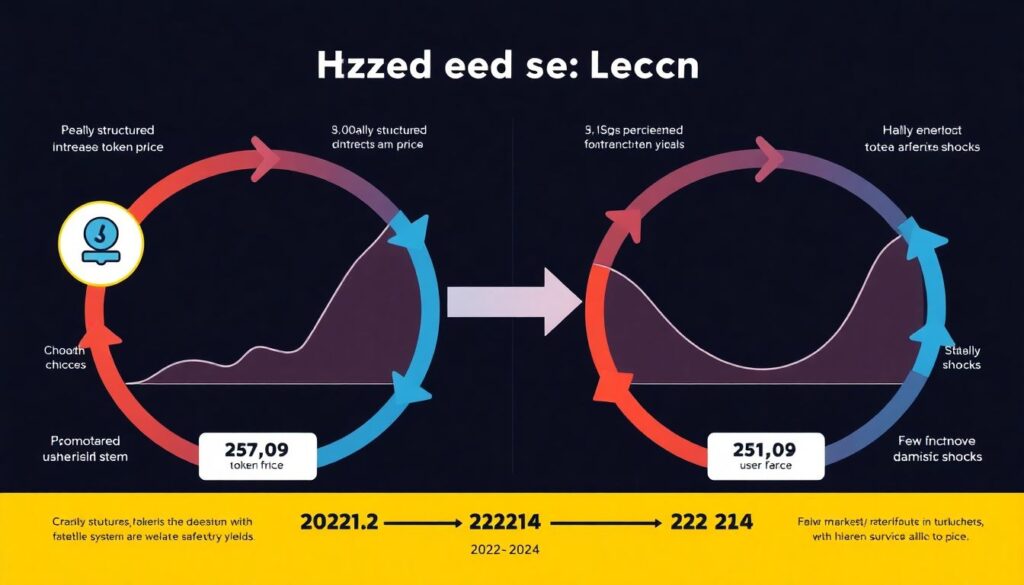
The economic mechanics of tokenized ecosystems are highly reflexive: user growth affects token price, which affects perceived safety and yields, which then feed back into growth. Poorly structured systems amplify shocks; well‑structured ones dampen them. Over 2022–2024, protocols that survived harsh conditions tended to pair conservative emissions with real revenue, sharing part of that revenue with token holders or stakers instead of relying solely on “printed” rewards. This approach gradually shifted market focus from “APY farming” to sustainable, risk‑adjusted yields, especially in RWA and lending platforms.
Several patterns now stand out as best practices for crypto monetary policy and inflation control. First, projects that front‑loaded emissions aggressively saw initial spikes in TVL and activity but then suffered long‑term overhang as investors anticipated constant sell pressure. Second, systems that shared a portion of fees in the base asset (e.g., ETH, stablecoins) while using the native token mainly for governance often enjoyed more stable demand. Third, explicit circuit breakers – like automatic reward reductions during price crashes – helped reduce death spirals. Together, these observations support a move toward hybrid models combining modest inflation with real yield.
For builders thinking through economic design, it helps to model three core flows: how new tokens enter circulation (issuance), how they exit (burns, slashing, or permanent locks), and how value moves between users, the treasury and external counterparties. If you can’t clearly articulate why someone would willingly hold or lock your token beyond short‑term speculation, it usually means your monetary policy is subsidizing behavior that won’t stick when market conditions change.
—
Industry impact: services, agencies and consulting

As token economics became more complex, a small ecosystem of specialists emerged around it. By 2024, a sizeable segment of advisory firms focused on tokenized ecosystem development and tokenomics agency work, combining economic modeling, legal coordination and go‑to‑market planning. These firms increasingly work alongside traditional auditors, helping projects demonstrate that their monetary frameworks are robust, auditable and compliant with emerging regulations on disclosures and consumer protection. The presence of such structured advisory capacity is one of the clearest signals that crypto is maturing beyond experimental phases.
At the same time, crypto token economy consulting for startups has turned into a distinct niche, particularly in hubs like Singapore, Dubai and certain EU jurisdictions. Early‑stage teams now routinely ask for scenario modeling, regulatory risk mapping and simulation of user incentives before launching a token. Instead of attaching a token at the last minute, founders design their product, economic loops and rollout strategy as a single package. This consultative approach reduces the risk of over‑promising yields or launching with misaligned incentives that are hard to correct after tokens are widely distributed.
For larger organizations – exchanges, fintechs, and even banks – the existence of specialized advisors lowers the barrier to entry. They no longer need to build in‑house teams of PhD economists and Solidity engineers to explore tokenized loyalty programs, RWA platforms or on‑chain fund structures. Instead, they can prototype with external partners, subject designs to third‑party review, and move toward deployment once the economic and regulatory models converge. This kind of modularity is accelerating institutional adoption of tokenization.
—
Forecasts to 2028: where tokenized monetary policy is heading

Looking ahead to roughly 2028, several trajectories appear more likely than not, assuming no catastrophic regulatory shocks. First, tokenization of traditional assets is poised to outgrow purely speculative DeFi. Various research houses and investment banks have projected that tokenized real‑world assets could reach the low‑trillion‑dollar range in value by the end of the decade if current growth rates persist. Even a conservative scenario where tokenized government debt and money‑market instruments reach a few hundred billion dollars by 2028 would already make them a major component of on‑chain liquidity.
Second, we should expect more convergence between public‑chain tokens, permissioned environments and central‑bank digital currency experiments. As CBDC pilots expand, many jurisdictions are exploring interoperability layers rather than isolated walled gardens. That will intensify pressure on open ecosystems to maintain transparent, predictable monetary rules, because institutions will be able to compare them directly with state‑backed digital money. Systems that can clearly demonstrate how risks are managed and how token holders are protected will likely attract a greater share of institutional flows.
Finally, tooling is improving quickly. Simulation platforms, risk dashboards and open‑source frameworks for emissions and governance are making it easier for smaller teams to avoid repeating past mistakes. In parallel, regulatory guidance on disclosures, marketing of yields and classification of tokens is slowly becoming more specific. In such an environment, projects that align their monetary design with emerging norms are positioned to scale faster, while those relying on opaque, hyper‑inflationary reward schemes will find it harder to list, raise or retain users.
—
Actionable guidance for builders and investors
If you’re designing or evaluating a token in 2025, treat monetary policy as a continuous process, not a static whitepaper section. Market conditions, regulation and user expectations will shift over the next few years. Embedding flexibility – within clear constraints – is your best hedge against uncertainty. Transparent dashboards, regular economic reviews and on‑chain governance updates help keep your community aligned and reduce the perception that policy changes are arbitrary or insider‑driven.
For founders and product teams, the following checklist is a good starting framework:
– Define the token’s economic roles before touching supply numbers or emissions charts.
– Map realistic sources of protocol revenue and connect them to token value through clear mechanisms.
– Model downside scenarios and pre‑commit to how monetary parameters will adapt.
– Document governance rules so investors know exactly how and when policy can change.
Investors and ecosystem partners can apply a parallel lens when judging projects. Ask whether the team has engaged qualified experts or relevant tokenomics design services for crypto projects, and whether their models have been independently stress‑tested. Look for alignment between narrative, product usage and monetary mechanics: if rewards are high but organic demand is thin, expect future policy reversals or painful dilution. Over the next cycle, disciplined monetary frameworks are likely to be one of the clearest differentiators between projects that endure and those that merely ride temporary waves.