Why AI-Guided Portfolio Construction Matters for Crypto Funds
Кrypto funds have a unique problem: the market never sleeps, correlations jump around like crazy, and liquidity can disappear in minutes. Traditional approaches from equity hedge funds help only partly. That’s where AI-guided portfolio construction comes in: instead of a static “set and forget” allocation, you get a system that continuously reads the market, recalculates risks, and suggests what to buy, hold, or cut — often faster than a human team could even open a spreadsheet.
In practice, this is not about letting a black box run your entire fund. The most successful funds use AI as a co-pilot: the models crunch the data, propose allocations and hedges, while humans set constraints, check assumptions, and veto obviously crazy ideas. Expert managers treat AI like an extremely diligent junior PM with superhuman pattern recognition — but still a junior that needs supervision and clear rules.
Core Tools Needed for AI-Guided Crypto Portfolios
Data, Infrastructure, and Analytics Stack
To build AI-driven portfolio construction, you need more than a couple of Python scripts and an exchange account. At minimum, funds rely on:
1. Clean, low-latency market data: spot prices, futures, options, funding rates, order books, volumes from multiple venues, plus on-chain data (flows, large wallet moves, staking and unstaking events).
2. Reliable infrastructure: cloud or on-prem servers with GPUs for training models, separate environments for research and production, plus logging and monitoring so you can audit every decision the system makes.
3. Analytics and experimentation tools: Jupyter-like environments, model versioning, and a way to run backtests quickly.
Many funds also use specialized crypto fund portfolio management software that plugs into exchanges, wallets, and custodians, providing real-time P&L, exposure by asset, and automated compliance checks. Expert managers insist on one rule: if your AI model can’t be traced back to positions and risk numbers in a single dashboard, it doesn’t belong in production.
AI Platforms, Engines, and Execution Layer
On top of the basic stack, you need a decision engine. Some teams build their own from scratch; others plug into an AI crypto trading and portfolio optimization platform that already includes data connectors, risk models, and execution.
Important components include:
– Signal engines (price, sentiment, on-chain, macro proxies).
– Portfolio optimizer (risk-parity, mean-variance, factor-based, or reinforcement learning).
– Execution layer (smart order routing, TWAP/VWAP, slippage and impact models).
Larger hedge funds often mix in the best crypto asset management tools for hedge funds with in-house models. Their expert advice is simple: don’t try to reinvent everything on day one. Start by integrating a few proven tools, then gradually replace parts with your own models as your team gains confidence.
Step-by-Step: From Idea to AI-Guided Portfolio
Step 1. Define Your Mandate and Constraints
Before touching any code, define the “box” your AI is allowed to play in. In practice:
1. Investment universe: which coins, DeFi tokens, derivatives, and stablecoins are in or out.
2. Constraints: leverage limits, per-asset caps, sector or theme caps (e.g., no more than 25% in DeFi), minimum liquidity, and counterparty rules.
3. Risk targets: max drawdown, target volatility, stress scenarios you want to survive (BTC -30% in 24h, exchange outage, stablecoin de-peg).
Experienced managers warn that skipping this step is the fastest way to blow up. If the model isn’t bound by position limits and liquidity rules, it will eventually “discover” a fragile but high-ROI niche you cannot scale or survive in live trading.
Step 2. Build a Robust Data Pipeline
Expert quants in crypto repeat one mantra: “garbage in — margin calls out.” You need a pipeline that:
1. Aggregates prices, volumes, and order books from several exchanges.
2. Normalizes symbols, quote currencies, timestamps, and corporate actions (airdrops, forks, token migrations).
3. Filters bad ticks, fat-finger trades, and obvious exchange glitches.
Many algorithmic crypto fund management services claim to handle data for you, but even then you should run your own sanity checks. For instance, if your feed says BTC traded at zero for a second, your models must not treat that as a real arbitrage. During backtests, experts recommend tracking how often your filters intervene; a spike usually signals a new data issue or an exchange behaving strangely.
Step 3. Design the Signal Layer (What the AI “Sees”)
AI needs features, not just raw candles. Common categories:
– Market microstructure features: bid-ask spreads, order book imbalances, depth, slippage estimates.
– Volatility and momentum: realized vol, intraday momentum, trend strength across timeframes.
– Flow and positioning: funding rates, basis between futures and spot, large holder flows, staking inflows/outflows.
– Regime indicators: risk-on vs risk-off periods, correlations with macro assets.
Expert tip: resist the temptation to throw in every possible indicator. Start with a small, interpretable set and only add new features when they clearly improve out-of-sample performance. Senior quants often keep a “feature graveyard” — a list of signals that looked amazing in-sample but died in real-time, to avoid reusing the same traps.
Step 4. Choose and Train Your Models
You don’t need deep reinforcement learning from day one. Professional funds often start with:
1. Gradient boosting or random forests for directional probability (up, flat, down).
2. Linear or penalized regressions for risk factor exposures (beta to BTC, market-neutral spreads).
3. Clustering models to identify market regimes (volatile chop, strong trend, low-liquidity weekends).
Once the foundation is stable, some teams add reinforcement learning to handle complex crypto trading strategies across multiple venues. But there’s a catch experts highlight: RL models are fragile when the environment changes, and crypto changes constantly. You need strict monitoring and kill switches, plus conservative sizing until you’ve seen the model survive at least one serious market crash.
Step 5. Portfolio Optimization and Position Sizing
After signals come portfolio weights. This is where your AI-guided system becomes a real allocator rather than just a signal generator. Common approaches:
– Risk-parity and volatility-scaling: scale positions so each asset contributes a similar share of risk.
– Mean-variance or CVaR optimization: maximize expected return for a given risk, using forecasts from your models.
– Scenario-based constraints: stress-test against BTC crashes, stablecoin de-pegs, or exchange outages, and cap positions that blow up too hard in those scenarios.
Many funds either use an AI crypto trading and portfolio optimization platform or build their own optimizer that incorporates execution costs. Expert PMs insist on this: if your optimizer ignores slippage and fees, it will love strategies that churn your book to death. Incorporate realistic transaction costs from day one, especially for small or illiquid tokens.
Step 6. Rebalancing Logic and Automation
Effective AI-guided portfolio construction isn’t just initial allocation; it’s continuous rebalancing. Modern funds increasingly rely on an AI-driven cryptocurrency portfolio rebalancing service that:
1. Monitors target weights versus actual weights in real-time.
2. Decides when deviations are large enough to justify trades, taking into account fees and slippage.
3. Chooses routes and venues to minimize market impact, possibly breaking trades into slices.
Senior traders recommend hybrid rules: let AI suggest rebalancing actions and timing, but enforce human review thresholds for very large or unusual trades. For example, anything that would change net BTC exposure by more than 10% in a day might require manual approval, no matter what the model says.
Step 7. Execution, Risk, and Compliance Integration
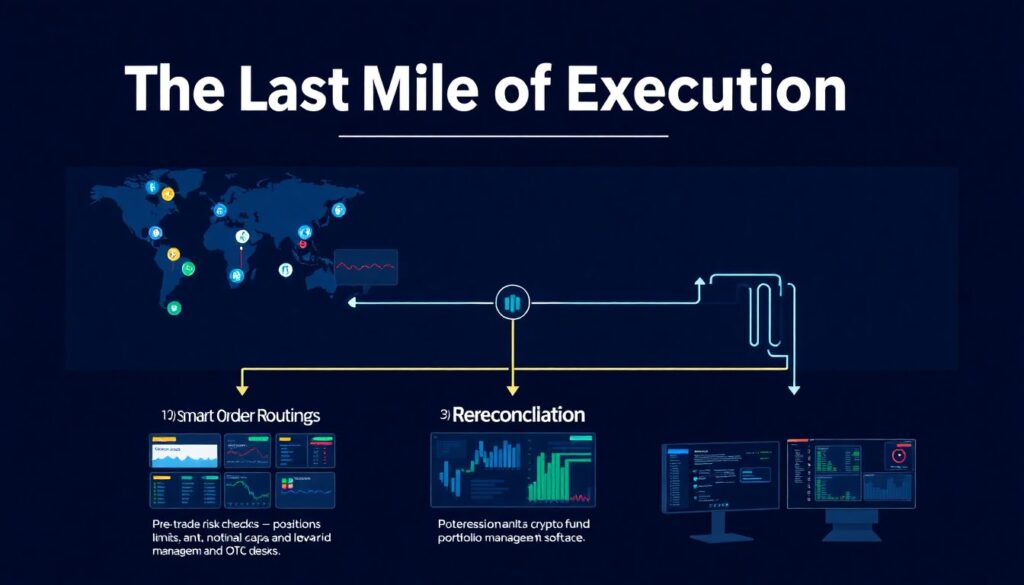
The last mile is where many clever systems fail. To avoid that, expert funds integrate:
– Smart order routing across exchanges and OTC desks.
– Pre-trade risk checks (position limits, notional caps, leverage rules).
– Post-trade reconciliation into the fund’s crypto fund portfolio management software.
At this stage, transparency matters more than raw performance. Your risk and compliance teams need to see: why a trade was suggested, which model produced the signal, and whether it followed the constraints. Seasoned managers require an audit trail of every automated decision; if a regulator or LP asks “why did you buy this illiquid token that day?”, you must be able to answer with data, not vibes.
Expert Recommendations for Running AI in Production
How Experienced Funds Keep Models Under Control
Managers who have run AI systems through multiple crypto cycles share a few non-negotiable habits:
1. Always run champion–challenger setups. Your live model (“champion”) runs the book, while alternative models (“challengers”) run on paper. When a challenger consistently outperforms with similar or lower risk for a meaningful period, you consider promoting it.
2. Separate research from production. Researchers can experiment wildly, but production models must meet strict stability, latency, and explainability standards. No last-minute model changes before major macro events.
3. Use human-in-the-loop review for edge cases. When volatility explodes, funding rates go extreme, or liquidity dries up, the system should automatically enter a “cautious mode” with tighter limits and require more human approvals.
One portfolio manager summed it up neatly: “Your biggest risk isn’t that AI is too smart. It’s that it’s relentlessly consistent at repeating a mistake you didn’t notice.”
Aligning AI With the Fund’s Strategy and LP Expectations
Not every fund should run hyper-optimized, high-frequency strategies. Some LPs want directional beta with smart risk management. Others want market-neutral yield. Your AI-guided framework must explicitly encode that mandate.
Experts suggest you write down an “AI constitution” for your fund, including:
– The types of strategies allowed (trend, carry, market-neutral, arbitrage, options).
– The max turnover and typical holding periods.
– The expected drawdown profile and recovery time.
This document is then translated into constraints, penalties, and evaluation metrics inside your AI system. When there is a clash between raw Sharpe and mandate (for example, the model loves a strategy your LPs consider too exotic), the mandate wins. That’s how seasoned managers avoid silent style drift.
Troubleshooting: When the AI Portfolio Misbehaves
Common Red Flags and What They Usually Mean
Even with a strong setup, things will go sideways. Expert managers look for specific symptoms:
– Sudden jump in turnover without higher returns – often caused by a data drift or a new spurious signal. Check recent model or feature changes, and compare live features against historical distributions.
– Model loads up on illiquid or obscure tokens – likely an artifact of backtests that underestimated slippage and regime changes. Tighten liquidity filters and raise the penalty on concentrated tail positions.
– Performance great in trending markets, terrible in chop – your model is regime-sensitive but regime-unaware. Add explicit regime classification and either scale exposure down in chop or switch to different strategies.
The most experienced funds run automated diagnostics daily: they compare realized slippage to forecast, volatility of P&L to target, and factor exposures over time. When any metric breaks its band, the system either reduces risk automatically or pages a human.
Debugging Models Without Getting Lost in Complexity
To avoid drowning in complexity, senior quants recommend a structured debugging approach:
1. Freeze the code and parameters. No changes until you understand the issue; otherwise, you’ll never know what actually broke.
2. Replay recent days in simulation. Feed the same data to the model, see if it reproduces the bad trades, and inspect intermediate signals.
3. Strip the model back. Temporarily turn off secondary signals and keep only the core ones. If performance stabilizes, reintroduce signals one by one and watch where the problem returns.
4. Stress-test with synthetic shocks. Inject BTC shocks, volatility spikes, or liquidity halts into your backtests. Robust AI portfolio systems should degrade gracefully; if your P&L curve falls off a cliff, you’ve found a structural weakness.
A practical expert tip: keep a “war room” playbook for crises. It should define who decides when to switch models off, how to de-risk the portfolio manually, and how to communicate with LPs about what went wrong and how you’re fixing it.
When to Turn the AI Off
There are rare but important times when the best action is to shut down or heavily throttle AI-driven trading:
– Major exchange hacks, chain halts, or regulatory black swan news.
– Structural breaks: new derivatives launches, rule changes, or permanent fee shifts at key venues.
– Data integrity events where you can’t trust what your system is seeing.
Seasoned crypto hedge fund managers are blunt about this: a disciplined shutdown during chaos will save your career more often than it will cost you a life-changing trade. AI is powerful, but it is not omniscient; your risk management and common sense must still be the final authority.
Putting It All Together
AI-guided portfolio construction for crypto funds is not a magic button; it’s a disciplined framework that blends robust data engineering, thoughtful modeling, strict risk controls, and clear human oversight. The winning teams use crypto fund portfolio management software for transparency, layer in algorithmic crypto fund management services for execution and monitoring, and then customize the brain of the system — the signals and optimizers — to reflect their unique edge and mandate.
If you treat AI as a partner — not a replacement — for experienced portfolio managers and quant researchers, you can build portfolios that react faster, adapt better, and withstand the wild regime shifts that define crypto. The technology is already good enough to give a real edge; the difference between funds that thrive and those that implode is not the math, but the discipline with which they design, supervise, and continuously stress-test their AI.
Комментарии