Why autonomous digital identity verification on blockchains matters
From “upload your passport” to “prove it with math”
Most online services still verify you the old-fashioned way: upload a document, wait for a human or semi-automated check, hope nothing gets flagged. Autonomous verification of digital identities on blockchains flips this model. Instead of sending raw documents everywhere, you carry cryptographic proofs. Services just run algorithms to verify those proofs on-chain or off-chain, without ever seeing your sensitive data. In other words, instead of “send us everything and trust we won’t leak it”, you get “keep your data, show us only what we need to know, and let the math prove it”. That’s the core shift behind modern blockchain digital identity verification solutions and why they’re drawing so much attention from both engineers and regulators.
Short version: you stop broadcasting your identity; you start broadcasting verifiable claims about it.
—
Key terms in plain language
To avoid confusion later, let’s sync on a few definitions.
– Digital identity: a structured set of attributes about a person or organization (name, age, license number, role) plus cryptographic keys that bind those attributes to a specific holder.
– Identifier: your “handle” in the system, like `did:example:12345`, not your passport number.
– Credential: a signed statement by some authority, such as “Bank A confirms this person passed KYC”.
– Verifier: the service that wants to check if a credential is valid.
– Autonomous verification: the verifier can check authenticity and integrity using open cryptographic rules and blockchain data, without calling the original issuer every time.
—
How autonomous verification actually works
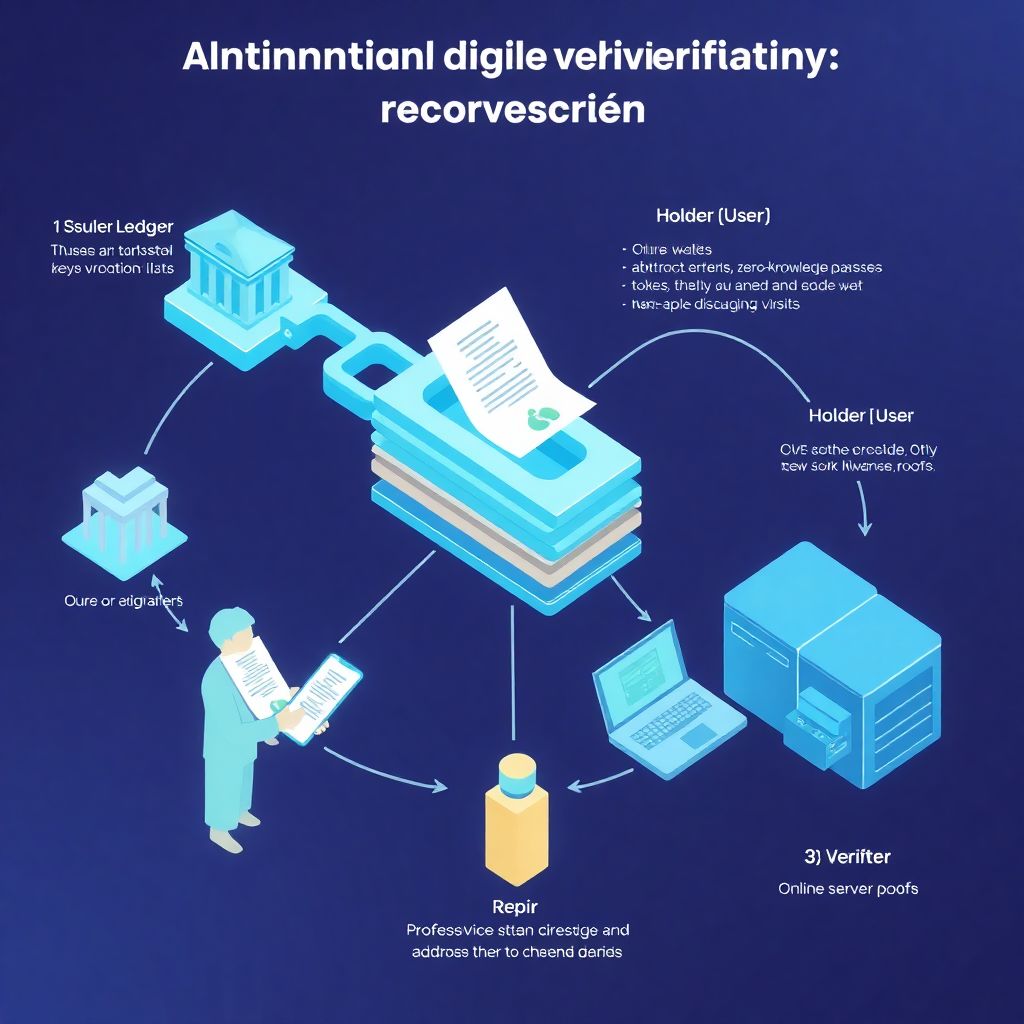
Here’s a simplified mental model you can keep in your head. Imagine three roles: issuer, holder, verifier. The issuer creates and signs a credential. The holder stores it in a wallet. The verifier checks the issuer’s signature against a public key stored on-chain. If it matches, the claim is considered authentic. No e‑mails, no PDFs, no “please wait, our compliance team is reviewing your document”. The “compliance team” is replaced by cryptographic protocols and immutable records. Blockchain plays two key roles here: it anchors public keys and revocation registries; and it timestamps events so verifiers can see whether a credential was valid at the moment of use, not just valid at some vague time in the past.
In essence, we replace “trust the process” with “verify the math”.
—
Text diagram: the basic flow
Try visualizing the flow like this:
Issuer → issues credential → Holder
Holder → presents proof → Verifier
Verifier → checks keys & revocation → Blockchain
Or a bit more detailed:
1. Issuer publishes public key on blockchain.
2. Issuer issues credential signed with private key.
3. Holder stores credential in wallet app.
4. Verifier receives cryptographic proof from holder.
5. Verifier looks up issuer key + revocation list on-chain.
6. Verifier runs verification algorithm; returns yes/no.
Nothing magic, just clear roles plus public state you can’t silently rewrite.
—
Where blockchain fits into digital identity
What lives on-chain and what really shouldn’t
A healthy expert consensus: never put raw personal data on a public blockchain. What you store instead are identifiers, public keys, and sometimes hashed references or revocation flags. Think of the blockchain as a giant, append-only bulletin board that says, “This public key belongs to this issuer, and here’s the current revocation status of credentials they’ve issued.” Your actual credentials and zero-knowledge proofs live in wallets, cloud storage, or specialized infrastructure. By keeping only the minimal metadata on-chain, you gain integrity and availability, while still respecting privacy and data protection rules. This separation of layers is exactly what lets autonomous verification scale: every verifier reads the same shared state, but none of them can see your underlying documents, only cryptographically transformed proofs extracted from them.
So the chain is the trust anchor, not the data lake.
—
Diagram: logical architecture
In text form, a typical architecture looks like:
[User Wallet]
↕ presents proofs
[Verifier Service]
↕ reads keys, schemas, revocations
[Blockchain Network]
↑
[Issuers publishing keys & status]
You can imagine arrows like this:
Issuers → Blockchain ← Verifiers
↑
Users (via proofs)
Each arrow represents a signed message or a proof exchange, not a file upload. The whole point is to minimize surface area where personal data can leak while still giving verifiers enough confidence to say “yes, this is legitimate”.
—
Autonomous vs traditional and semi-digital verification
How it compares to legacy KYC and identity checks
Compare this to traditional KYC. Today, a bank or exchange will run a KYC identity verification using blockchain technology mostly as a buzzword, while still relying on centralized databases and manual review. You upload documents; a vendor screens them, maybe extracts text with OCR, and stores everything for years to satisfy audits. Every new service repeats the same process from scratch, multiplying your exposure. Autonomous blockchain-based verification changes the dynamic: once a trusted issuer has confirmed your identity and issued you a credential, you can reuse it across multiple verifiers. They all check the same issuer key and revocation list on-chain. This drastically cuts repeated KYC friction, reduces time to onboarding, and limits the number of databases holding your personal data.
So instead of many silos, you get one set of verifiable claims you can carry anywhere.
—
Compared with federated login and SSO
Think about “Login with Google” or corporate single sign-on. That’s convenient, but not exactly autonomous. The verifier calls back to the identity provider on each login and relies on that provider being online, honest, and not compromised. If your provider locks your account, a huge chunk of your digital life disappears. With a more autonomous, decentralized digital ID verification service, you shift control to keys and credentials you can back up and rotate. Verifiers no longer need a live connection to Google or any other silo; they just need to validate signatures against public data recorded on-chain. You still might use federation inside a company, but the underlying trust is rooted in a public, tamper‑resistant infrastructure instead of a single vendor’s database and uptime.
Put differently, SSO is trust-by-contract; autonomous verification is trust-by-protocol.
—
Self-sovereign identity and autonomy
What “self-sovereign” really implies
A self-sovereign identity platform on blockchain aims to let you own and manage your identifiers, keys, and credentials without being permanently tied to a single provider. You can rotate keys, move your wallet, and selectively share claims. In this model, “autonomous verification” doesn’t just mean the verifier is autonomous from the issuer; it also means the user is less dependent on centralized account recovery and opaque risk scoring. When you present a proof to a verifier, you decide which attributes they see and which stay hidden, often via zero-knowledge techniques. This gives you two parallel freedoms: freedom from re-uploading documents everywhere, and freedom from being profiled based on unnecessary data. Experts emphasize that true self‑sovereignty also requires good UX and recovery models; without that, users either lose access or fall back to centralized custodians.
Control without usability is just theoretical freedom.
—
Expert recommendations for self-sovereign setups

Identity architects who’ve shipped real systems tend to give similar advice. First, design for key loss from day one: social recovery, hardware wallets, or institutional escrow, but always user‑centric and auditable. Second, assume users don’t read long explanations, so create clear “data sharing moments” with one‑screen summaries of what will be revealed and why. Third, don’t try to decentralize everything; keep human support and dispute resolution available, but make those processes transparent and logged. Finally, keep protocol interoperability as a top‑level requirement. If your shiny SSI platform only works with itself, it’s just a nicer silo. Following this guidance, self‑sovereign doesn’t mean “you’re on your own”; it means “you’re in charge, with guardrails”.
—
Enterprise and regulatory angles
Why big companies are even considering this
From an organization’s perspective, storing copies of passports and utility bills is a liability magnet. Data breaches get expensive fast. That’s why enterprise blockchain identity management software is starting to focus on minimizing what the company stores. With autonomous verification, the enterprise mainly keeps transaction logs and proof receipts, not the raw identity documents. When auditors arrive, the company can replay verification steps using public ledger data and archived proofs, demonstrating compliance without pouring through mountains of sensitive files. This also plays nicely with multi-jurisdiction operations: different branches can rely on the same global trust fabric while applying local policy rules at the edge. The result is less duplicated infrastructure, easier audits, and a smaller blast radius in case something does go wrong.
Security and cost savings tend to convince even skeptical CFOs.
—
Regulators’ evolving stance
Regulators are cautious but curious. They like strong audit trails, predictable risk, and clear accountability. Autonomous verification gives them something interesting: cryptographically provable histories of who checked what and when, plus instantly visible revocation and status changes. There are, however, serious questions around data protection laws, especially when public ledgers are involved. Expert legal advice typically boils down to three rules: don’t put personal data on public chains; design revocation mechanisms that don’t require altering historical records; and implement privacy-preserving analytics so institutions can report risk metrics without deanonymizing users. Regulatory sandboxes in several regions are already testing this mix, and feedback from those projects strongly influences how the next generation of standards is shaping up.
The systems that win will be those regulators can understand and trust, not just admire technically.
—
Realistic use cases and examples
Financial onboarding and beyond
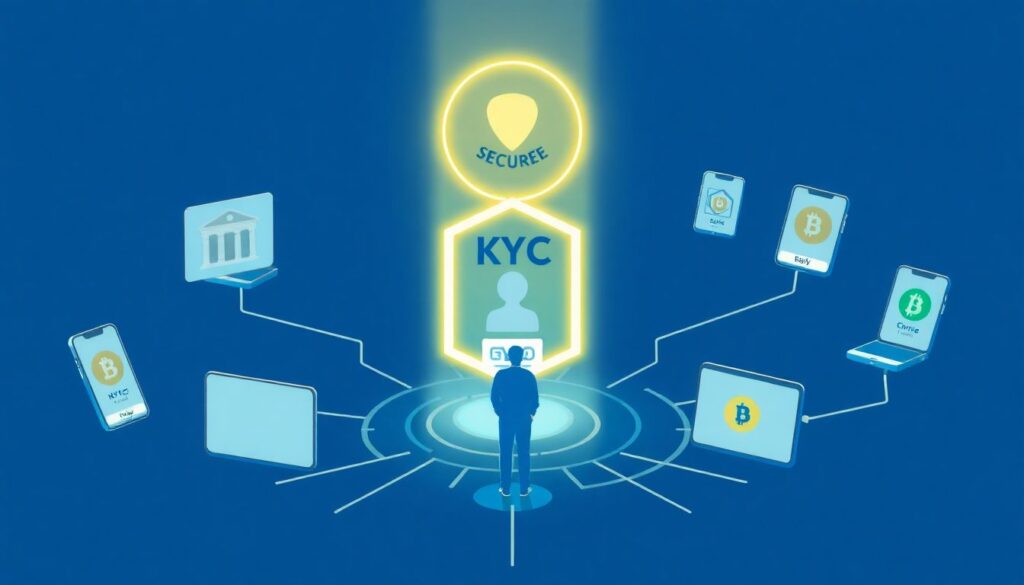
The most obvious application is banking and crypto onboarding. Instead of each platform running its own heavyweight checks, a trusted provider (say, a licensed KYC utility) issues you a credential once. You then use that credential to open accounts at other services, which verify it autonomously. If the provider later discovers fraud, it revokes the credential on-chain; all verifiers see the updated status in near real time. Similar patterns work for employee access to sensitive systems, age‑restricted content, or cross-border travel documentation. Already, some blockchain digital identity verification solutions are experimenting with layered credentials, where a base KYC is enriched with sector-specific attributes like professional licenses or accredited investor status that can be proven selectively.
Think of it as a modular passport you can customize by context.
—
Diagram: selective disclosure in practice
A simple text sketch:
[Full Credential: {name, DOB, address, photo, status}]
↓ derive proof
[Proof: “holder is over 18” + signature]
→ sent to verifier
Verifier → checks:
1) proof signature valid?
2) issuer trusted and not revoked on-chain?
3) constraint (“over 18”) satisfied?
The verifier never sees your name or address, only that a recognized issuer certifies your age. With zero-knowledge proofs, this logic can get quite sophisticated, like “user’s income is in range X–Y” or “user belongs to EU jurisdiction,” all without leaking precise values.
—
Design patterns and expert advice
What engineers should prioritize
Engineers building a decentralized digital ID verification service are often tempted to focus on cryptographic novelty. Seasoned experts advise the opposite: start with threat modeling and usability. Ask who your adversaries really are: insiders, fraudsters, nation-state actors, or simply buggy integrations. Then decide which crypto building blocks you actually need. Many systems can get very far with well‑tested signature schemes, revocation registries, and straightforward proofs. Zero-knowledge machinery is powerful but can be overkill if you don’t have a clear privacy requirement. Another expert tip: design your APIs so that verifiers don’t have to be identity experts. Provide a “verifyClaim(…)” interface that abstracts away low-level protocol details while still exposing enough metadata for compliance logging.
Elegant protocols are useless if nobody integrates them correctly.
—
Key expert recommendations in one place
Pulling together repeated themes from practitioners:
– Minimize data: prove properties, not identities, whenever possible.
– Standardize flows: reuse open standards like DID, Verifiable Credentials, and OIDC bridges instead of inventing your own stack.
– Plan for rotations and revocations: keys will leak, issuers will change, legal frameworks will evolve.
– Observe the user journey: verify that people actually understand what they’re sharing; run usability testing, not just unit tests.
– Treat blockchains as coordination layers: not application servers; keep logic and identities at the edge.
The systems that survive first contact with the real world balance these constraints rather than obsessing over any single metric.
—
Where this is heading
The future of identity: more math, less paperwork
Taken together, these trends point toward a world where proving who you are relies less on photocopies and more on formal proofs anchored in shared, tamper‑resistant infrastructure. Autonomous verification of digital identities on blockchains won’t eliminate all central authorities, but it will change their role: from gatekeepers hoarding data to issuers and auditors operating on transparent, interoperable rails. As tooling matures and more regulators gain hands‑on experience, expect tighter integrations with existing login systems, smoother recovery flows, and broader consumer-facing wallets that manage identity alongside payments. In that world, blockchain fades into the background. People won’t say “I used a blockchain ID today”; they’ll just notice that sign-up took seconds, their data stayed with them, and yet everyone involved could still trust the outcome. That’s the real win.
And if you’re designing such systems now, you’re helping define what “identity” will mean online for the next few decades.