
Why sentiment suddenly matters so much in crypto
If you’ve watched crypto markets over the past few years, you’ve probably noticed that prices don’t just follow on-chain metrics or macro data. They whip around based on tweets, Telegram rumors, Reddit threads and regulatory headlines. In 2025 this is even more pronounced than during the DeFi and NFT booms: narrative cycles are faster, attention windows are shorter, and “risk-on / risk-off” switches happen almost in real time. This is exactly why AI-guided sentiment analysis for crypto markets has moved from being a niche experiment to a core part of professional trading stacks. Instead of manually scrolling X (Twitter), Discord and news feeds, traders now lean on systems that read millions of messages per hour, classify tone, detect shifts in crowd mood and convert those into structured indicators.
Что такое AI‑guided sentiment analysis в крипте на практике
In simple terms, AI-guided sentiment analysis is about teaching models to understand how people “feel” about coins, sectors or the market as a whole, and then wiring that into trading decisions. The difference versus the old “fear & greed” indexes is precision and context. Modern crypto market sentiment analysis tools ingest social media posts, news headlines, forum comments, GitHub activity and sometimes even order-book microstructure. Using transformer-based language models and domain‑specific lexicons, they score each data point on axes like bullish–bearish, confidence level, topic cluster and potential market impact. On top of that, reinforcement-learning layers can tie these scores to actual price reactions, so the system slowly learns which types of sentiment patterns historically led to tradable moves and which were just noise.
Key data points: what the stats say in 2025
By the mid‑2020s, sentiment is no longer a soft, “nice to have” overlay. Internal studies published by several quant funds show that sentiment-driven features now account for 15–30% of the explanatory power in short-horizon crypto return models, especially on smaller-cap assets where fundamentals are thin. Vendors report that institutional adoption of AI sentiment analysis crypto trading solutions has grown at double‑digit rates annually since 2021, with some data providers processing upwards of 500 million social and news messages per day across dozens of languages. Backtests shared in industry conferences commonly show that integrating real-time cryptocurrency sentiment analysis into intraday strategies can reduce drawdowns by 10–20% while slightly improving Sharpe ratios, primarily by avoiding entries during negative-information cascades and by scaling risk during sentiment-driven breakouts.
Как AI меняет workflow трейдера и аналитика
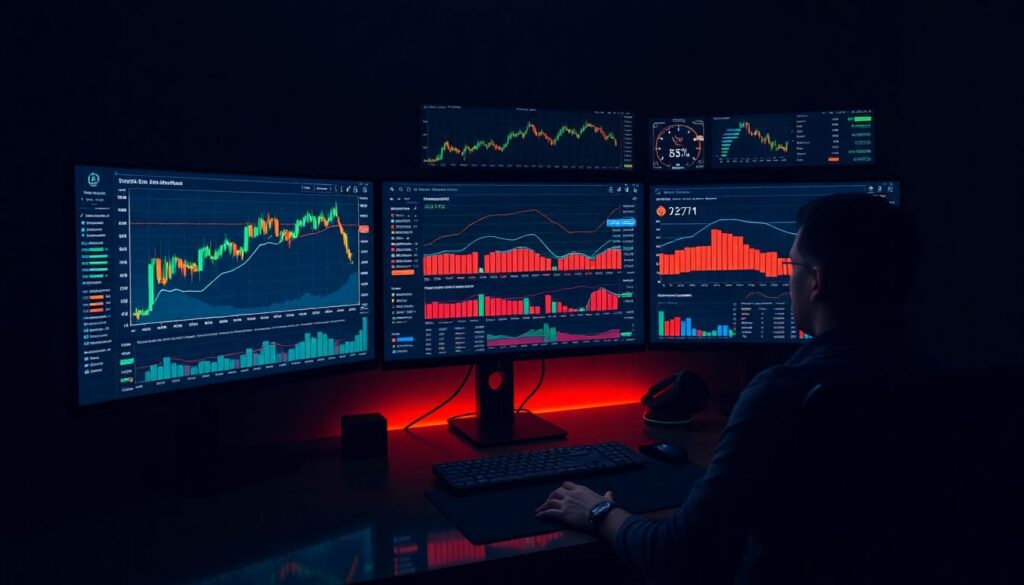
On the trading desk, the impact is felt at the workflow level. Instead of starting the day with a raw price chart, many discretionary traders open a sentiment dashboard that highlights where crowd mood diverges from price action. If a token is grinding higher on flat or deteriorating sentiment, that often flags exhaustion; if it sells off while sentiment quietly improves, that may hint at accumulation. For quants, machine learning sentiment analysis for crypto investors becomes just another factor to plug into models, but an unusually rich one: it can be decomposed into metrics like influencer divergence, news intensity, or retail vs. institutional tone. This lets them build execution rules such as “fade short signals during positive, low‑volatility sentiment regimes” or “only deploy mean‑reversion when news flow is neutral and social chatter is thinning out.”
Modern trend: from naive word counts to context‑aware models
Earlier attempts at sentiment used crude dictionaries: “moon” = bullish, “rug” = bearish, and so on. That breaks down fast in crypto, where sarcasm, memes and multi‑language slang evolve weekly. The modern trend is to fine‑tune large language models on domain-specific corpora so they learn nuances like “ngmi” vs. “actually bullish cope,” or distinguish playful FUD from credible risk alerts. In 2025, leading crypto market sentiment analysis tools increasingly rely on multi‑task models that do more than score polarity. They classify narratives (e.g., “regulation,” “L2 scaling,” “AI x crypto”), detect coordinated campaigns, and assign a probability that a given cluster of messages is bot‑generated. This richer context matters: a wall of positive messages from newly-created accounts is a very different signal from a smaller but coherent shift among long‑standing, high‑reputation traders.
Real-time signals: shrinking the reaction window
The biggest operational shift is latency. News‑based trading used to mean reacting within minutes; now, with AI-powered crypto trading signals, we’re talking seconds if not sub‑second alerts. Systems subscribe to firehose APIs from X, major exchanges’ WebSockets and news wires, scoring documents and order-book changes as they appear. When a large account posts about a critical vulnerability or a major listing, models can flag the sentiment impact, estimate potential spread to other assets, and alert traders almost instantly. This speed doesn’t magically guarantee profit—everyone else is getting faster too—but it redistributes edge towards teams that can integrate real-time cryptocurrency sentiment analysis with execution algorithms, risk controls and smart order routing to capture moves before they saturate.
Экономические аспекты: кто платит и за что
There’s a clear economic logic behind the boom in AI sentiment products. On the supply side, data vendors monetize access to curated, deduplicated and labeled streams that would be impossible for a single firm to build cheaply. Pricing typically scales by coverage, historical depth and latency, with premium packages including custom model training and proprietary “alpha scores.” On the demand side, funds justify spending six or seven figures a year because even small performance improvements compound. If an AI-guided overlay trims drawdowns, reduces slippage around news events or allows tighter leverage control, that can translate into millions saved across a large book. For retail brokerages and exchanges, embedding sentiment tools into their platforms increases user engagement and trading volume, which in turn boosts fee revenues and order‑flow value.
Where the edge actually comes from
Despite the hype, raw sentiment scores alone rarely confer lasting alpha. The real economic edge arises from combining them with structure: regime detection, risk budgeting and execution intelligence. For example, some desks only trust sentiment signals during “information-heavy” regimes, when volumes and news counts spike beyond a rolling threshold. Others use AI sentiment analysis crypto trading indicators as a veto: a strategy may have a technical long entry, but if macro or regulatory sentiment turns sharply negative, size is cut or the trade is skipped. There’s also growing interest in second‑order effects—how sentiment on one asset class (equities, AI stocks, macro) spills into crypto risk appetite—leading to cross‑asset models that track crowd mood across markets rather than treating crypto in isolation.
Прогнозы развития: что изменится к концу десятилетия
Looking ahead, several trajectories seem plausible. First, we should see more personalization: instead of generic “bullish/bearish” labels, systems will learn a given firm’s style and risk tolerance, reshaping the signals to what historically worked for that team. Second, multimodal inputs will matter more. Text is dominant today, but voice spaces, video streams and even on‑chain governance debates carry sentiment. By 2030, it’s reasonable to expect standard tools to parse audio AMAs, categorize speaker tone, and integrate that alongside text and price data. Third, regulation is likely to tighten around both data usage and manipulation, shaping how far sentiment-based targeting can go. As compliance frameworks mature, the gap may widen between fully regulated AI stacks used by institutions and the more experimental setups favoured by retail‑oriented platforms.
Risks, biases and systemic side effects
The flip side of widespread adoption is systemic risk. If many funds follow similar AI-guided sentiment regimes, their behavior can synchronize, amplifying volatility. Imagine dozens of models detecting negative sentiment and de‑risking at once—the result is a sharper cascade than fundamentals alone would justify. There’s also the issue of bias: models may under‑represent regions or languages that lack data, skewing perceived sentiment towards English‑speaking communities. Adversarial actors can attempt to game signals by coordinating posts, spinning up bots or exploiting known classifier weaknesses. Serious players now treat sentiment models as something that must be monitored like any other risk engine: they run stress tests, adversarial simulations and fairness audits, and maintain fallback logic to avoid blindly following model outputs during anomalous periods.
Как AI меняет структуру самой индустрии
On an industry level, AI-guided sentiment analysis is quietly redrawing the map of who has power in crypto markets. Data providers and infra companies—those who own the pipelines, annotation tools and models—are capturing a growing share of value relative to pure trading firms. Exchanges that offer built‑in crypto market sentiment analysis tools attract users who want “smart dashboards” rather than bare order books, reinforcing platform lock‑in. At the same time, traditional asset managers entering digital assets are more comfortable when they can plug crypto into familiar factor and sentiment frameworks, which accelerates institutionalization. Over time, this may dampen some of the wild, purely narrative‑driven bubbles, while making crowd mood swings more tightly integrated with macro risk cycles.
Practical uses for different types of market participants
Different actors touch sentiment AI in different ways. Retail traders typically meet it through simplified overlays and alerts, while professionals integrate it deeper into their stack:
– Discretionary traders: use dashboards for narrative discovery, contrarian setups, and timing around news or unlocks.
– Quants and HFT desks: treat sentiment as a set of features feeding forecasting models, microstructure rules and execution throttles.
– Exchanges and brokers: embed simplified scores into UI to boost engagement, and provide APIs for advanced users.
On the investment side, wealth managers and family offices increasingly look at machine learning sentiment analysis for crypto investors as a risk‑management tool more than an alpha factory, relying on it to flag crowding, retail euphoria or building FUD around holdings.
What to look for in modern sentiment tools
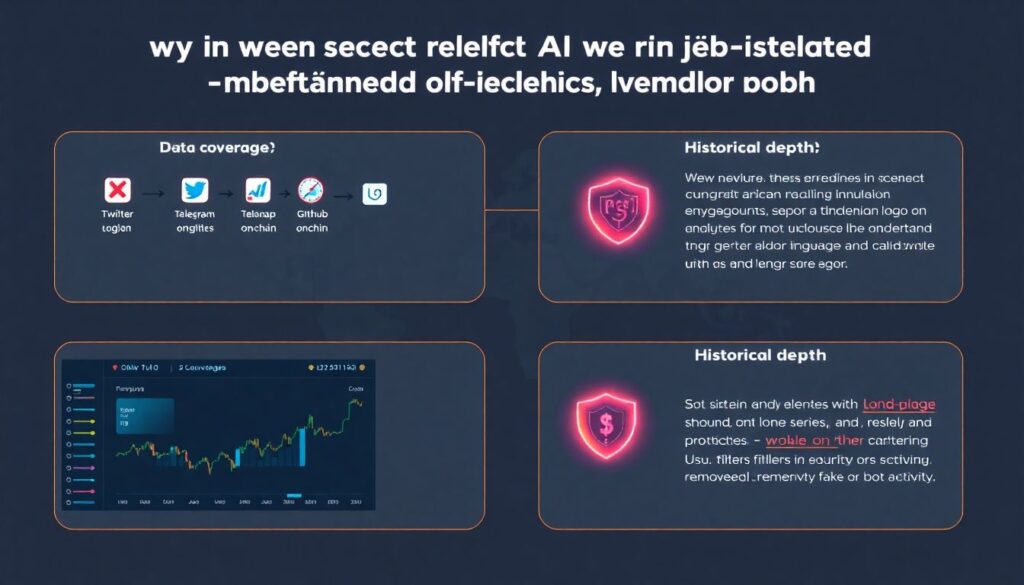
Given the crowded vendor landscape, choosing credible AI-powered crypto trading signals and analytics platforms requires a bit of due diligence. Some of the most relevant aspects include:
– Data coverage: sources (X, Telegram, news, GitHub, on‑chain), languages, historical depth and bot‑filtering sophistication.
– Model transparency: clarity on how scores are calculated, what “confidence” means, and how frequently models are retrained.
– Integration options: APIs, WebSockets, SDKs, and whether signals can be aligned with your specific timeframes and risk profile.
Serious teams also ask for out‑of‑sample tests, performance in crisis periods, and evidence that the vendor understands crypto‑native language rather than just repurposing generic NLP.
Conclusion: sentiment as a structural input, not a magic trick

AI-guided sentiment analysis for crypto markets has matured from an experimental add‑on into a structural component of how the space operates. It doesn’t replace fundamentals, macro, or on‑chain analytics, but it does fill a previously under‑quantified gap: how human (and increasingly bot) emotions, narratives and expectations translate into flows. In the 2025 landscape—where information spreads instantly and narratives can make or break tokens in days—the teams who treat sentiment as a disciplined, data‑driven input rather than a curiosity are the ones most likely to stay ahead of the next cycle, instead of being dragged along by it.