
The phrase “blockchain-enabled reproducible research with AI” sounds buzzword-heavy, but under the surface there’s a real, practical problem: we can’t reliably trust or rerun a lot of today’s AI experiments. Let’s unpack how blockchain can actually help, what alternatives exist, and where the money and industry pressure are pushing things.
—
Why reproducible AI research is so fragile today
AI research is hitting the same reproducibility wall that other fields hit years ago, just at a bigger scale. A widely cited Nature survey found that over 70% of researchers had tried and failed to reproduce another scientist’s experiments; in some disciplines it was over 80%. In machine learning, the situation is worse because:
– Datasets are often private, mutable, or under NDA
– Model weights change as teams “hotfix” bugs without versioning
– Training pipelines are glued together with scripts that never get published
– Hyperparameters and random seeds are not tracked rigorously
So when a paper says “we beat the baseline by 2.3%,” reproducing that result often requires detective work, insider access, or just luck. That’s not a sustainable foundation for AI-driven science, regulation, or safety.
—
Traditional fixes: good, useful… and limited

Before talking blockchain, it’s worth looking at the existing toolbox. There are three main families of solutions that try to fix reproducible AI research without touching blockchains.
Long paragraph:
1. Open code and data repositories. GitHub, GitLab, Zenodo, OSF and similar platforms allow researchers to share code, notebooks, and sometimes datasets. This is the backbone of many reproducible workflows, and it works well for many labs. But there are gaps: repositories can be edited or deleted; data often sit behind broken links; and there’s no built-in guarantee that the code that produced a figure is exactly what you’re looking at now, versus a quietly updated commit.
2. Containerization and workflow tools. Docker, Singularity, Conda environments, and workflow managers (Snakemake, Nextflow, Airflow, Kubeflow) try to lock in the full environment: libraries, OS image, and execution graph. This helps a lot with “it works on my machine” issues. Yet these tools assume honest use: someone can still regenerate a figure after changing a dataset, then tag the container as if nothing happened.
3. Centralized reproducible research platforms. Several cloud providers and startups offer hosted environments where you can run, log, and archive experiments. They often come with experiment-tracking dashboards, versioned datasets, and access control. But they are essentially trusted third parties: if the provider is compromised, pressured, or just changes business model, your “ground truth” record is at risk. There’s also the classic vendor-lock‑in problem.
Short paragraph:
These approaches are valuable and widely used, but they don’t tackle one core issue: how do we prove, years later, that a specific experiment ran with specific inputs and produced specific outputs — without relying on trust in a single organization?
—
What blockchain actually brings to reproducible AI research
Stripping away the hype, blockchain is basically an append‑only, tamper‑evident log maintained by a distributed network. For reproducible research, that suggests a simple idea: treat every important artifact of an experiment as a record that gets hashed and anchored to a shared ledger.
A blockchain reproducible research platform typically does not store whole datasets or models on-chain (that would be slow and expensive). Instead, it stores:
– Cryptographic hashes of datasets, model weights, and code snapshots
– Metadata about training runs (hyperparameters, environment, seeds, timestamps)
– References (URIs, content IDs from IPFS or other storage) to the actual data
– Optional signatures from institutions or reviewers
This setup turns the blockchain into a time‑stamped notary service for science. If someone wants to verify a result later, they can recompute the hash of the data and model, compare it to the on‑chain record, and instantly see whether something has changed.
Shorter:
In other words, the chain doesn’t run your experiments. It acts as a public, independently verifiable log that backs up claims like: “This exact version of the model, trained on this exact data, produced this result on this date.”
—
Comparing three main approaches: centralized, open-source, and blockchain-enabled
To make this concrete, it helps to compare three broad strategies researchers can use.
1. Centralized experiment platforms (SaaS).
Services like MLflow-as-a-service, Weights & Biases, or custom cloud dashboards are easy to adopt, integrate with existing MLOps, and provide nice UX. Their main weakness is central trust: if a provider lets users edit logs retroactively, or if logs are tampered with internally, it’s hard to detect. Also, long-term preservation depends on the company’s survival and policies.
2. Purely open-source, self‑hosted stacks.
Here you combine Git, containers, object storage, and experiment trackers under your institution’s control. This improves transparency and can be audited internally, but still relies on the institution as a single point of failure. If the admin modifies logs or quietly replaces a dataset, outside observers have no immediate, cryptographic way to notice.
3. Hybrid stacks with blockchain anchoring.
This is where blockchain-enabled reproducible research with AI comes in: you keep using the familiar tools (Git, DVC, MLflow, etc.) but for each experiment milestone, the system automatically writes a compact summary (hashes + metadata) to a public or consortium blockchain. Now even if your storage system gets corrupted, the on-chain record of what existed and when remains independently checkable.
Short comparison:
The trade-off is clear: centralized and open-source approaches optimize convenience and performance, while blockchain‑anchored workflows optimize traceability and auditability, at the cost of more architectural complexity.
—
How ai blockchain data integrity solutions work in practice
In practical deployments, ai blockchain data integrity solutions usually sit as a thin layer between your research stack and the blockchain node. When an experiment finishes, a small client collects:
– Hashes of input data partitions
– The commit ID of the training code
– The configuration (hyperparameters, environment details)
– Output metrics and, optionally, a hash of the model weights
The client then creates a signed transaction embedding this information (or a compressed representation) and sends it to the blockchain. The transaction ID becomes a permanent, globally visible reference to that exact experiment run.
For privacy and regulatory reasons, sensitive data stay off-chain. Systems typically combine blockchains with storage layers like S3, on‑prem clusters, IPFS, or specialized archives. The chain acts as a coordination and verification fabric, not as a database.
Short paragraph:
This approach essentially transforms opaque “we ran some code” claims into verifiable, time‑stamped commitments that any third party can challenge or audit.
—
Economic incentives: why anyone would pay for this
Reproducibility isn’t just a philosophical issue; it has economic weight. Failed replications waste grant money and compute time. In large AI projects, a single full-scale training run can cost tens or hundreds of thousands of dollars in GPU time. When a model can’t be reliably retrained, organizations face hidden liabilities: irreproducible safety tests, unverifiable compliance, and shaky IP claims.
Market analysts tracking blockchain for scientific research data management estimate healthy double‑digit annual growth rates over the next several years, even though the absolute market size is still relatively modest (in the low hundreds of millions of dollars worldwide by the end of the decade). The drivers are:
– Growing regulatory pressure on data provenance in healthcare, finance, and public policy
– Rising costs of large‑scale AI experiments, which make repeatability economically critical
– Increased collaboration between industry and academia, where contractual proof of who did what and when matters for patents, licensing, and liability
Shorter point:
From an industry CFO’s viewpoint, paying a small premium for trustworthy audit trails is cheaper than paying later for litigation, recalls, or regulatory penalties.
—
Forecasts: how fast will blockchain-enabled reproducibility spread?
Most forecasts should be taken cautiously, but several trends are pretty robust.
First, as AI models are embedded in high‑stakes decisions — drug discovery, clinical diagnosis, credit scoring, infrastructure control — regulators are moving toward demanding detailed, verifiable evidence of how models were trained and evaluated. Within the next 5–10 years, it’s plausible that for certain regulated sectors, secure ai research with blockchain services (or equivalent tamper‑evident logging) will become a de‑facto standard, not an experiment.
Second, distributed research collaborations are on the rise: consortia pooling data, federated learning across hospitals, multi‑company AI safety benchmarks. In these settings, no single participant wants to rely entirely on another’s logs. A shared ledger that records experiment histories is a natural fit, and the marginal cost per recorded experiment falls as infrastructure matures.
Short forecast:
So, while we’re unlikely to see every PhD student directly interacting with blockchains, there’s a credible path where a sizable share of serious, high‑impact AI research quietly runs atop blockchain‑backed validation layers.
—
Comparing data management models: central, federated, and blockchain-backed
Now let’s focus specifically on blockchain for scientific research data management and compare three patterns.
1. Central data lake model.
Everything is stored and versioned in a single huge repository (often cloud-based). Access control, logging, and version history are managed by the operator. This is efficient but brittle: if permissions are misconfigured or logs are altered, external parties have limited recourse.
2. Federated and distributed model.
Datasets stay within their home institutions; only aggregated statistics, gradients, or derived artifacts are shared. This improves privacy and regulatory compliance, especially in medicine. However, coordinating data versions and ensuring everyone used the correct snapshot at a given time becomes complex.
3. Blockchain-backed federated model.
Here, data remain local or in conventional storage, but each institution periodically commits hashes of their datasets and models to a shared ledger. That transforms cross‑institution experiments into something that can be audited later: if a hospital claims to have used dataset version X, another party can recompute the hash of X and check it against the ledger.
Short comparison:
Federated learning without a trustworthy coordination layer can devolve into “trust us” claims; adding a ledger doesn’t magically fix everything, but it strongly constrains misreporting and silent changes.
—
Tools and stacks: where blockchain fits into AI workflows
The most realistic path forward isn’t ripping out existing tools, but extending them. Several emerging systems act as blockchain-based reproducible ai experiments tools, layering integrity checks on top of standard AI pipelines:
– Version control (Git, DVC, or similar) still manages source code and data diffs.
– Experiment trackers (MLflow, Sacred, or custom logs) capture parameters and metrics.
– Container or environment managers define reproducible execution environments.
– A blockchain connector periodically packages critical metadata into signed transactions.
In this design, the “blockchain part” is not where researchers spend their time; it’s an automated pipeline step, analogous to pushing tags to a remote repository. The key challenge is designing schemas and policies that decide which events are worth anchoring (e.g., only published results, or every training run).
Short paragraph:
The more seamlessly these tools integrate, the more likely researchers are to use them by default rather than as an extra chore.
—
Direct comparisons: when blockchain helps, and when it’s overkill
To evaluate solutions honestly, it helps to compare them on specific dimensions.
1. Trust and auditability
– Purely centralized tools: good internal audit trails, weak external assurance.
– Open-source/self‑hosted: improves internal control, but external parties must still trust logs.
– Blockchain‑anchored: strongest defense against undetected tampering, especially for third‑party audits.
2. Performance and cost
– Centralized: usually fastest and cheapest per experiment; all infrastructure tailored to the provider’s stack.
– Open-source: cost-effective at scale but requires internal DevOps expertise.
– Blockchain‑anchored: overhead is modest if only hashes and metadata are written, but there’s added complexity around node maintenance, gas fees (for public chains), or consortium governance (for private chains).
3. Privacy and compliance
– Centralized: depends on provider’s certifications and contracts.
– Open-source: data can fully reside in regulated environments.
– Blockchain‑anchored: must be carefully designed to keep personal or sensitive data off‑chain; the chain stores only non‑identifying hashes and metadata. Done right, it can actually simplify proving compliance: you show that your process and datasets matched pre‑committed fingerprints.
4. Long-term verifiability
– Centralized: tied to provider continuity and backup policies.
– Open-source: tied to institutional continuity.
– Blockchain‑anchored: as long as the chain is alive and replicated, verification remains possible, even if original organizations disappear.
Short takeaway:
Blockchain is not a silver bullet, but it clearly wins on independent verifiability and tamper resistance. For low‑stakes internal experiments, that might be unnecessary. For high‑stakes or regulated AI, those properties start looking like requirements rather than luxuries.
—
Sector-by-sector impact on industry
Different industries feel these pressures in different ways.
– Pharmaceuticals and biotech.
AI‑assisted drug discovery and clinical decision support systems must meet strict regulatory scrutiny. If regulators start asking for cryptographically verifiable evidence of how models were trained and validated, blockchain‑anchored pipelines could become standard in clinical AI trials.
– Finance and insurance.
Credit models, fraud detection, and risk scoring increasingly use complex ML. When challenged by regulators or in court, being able to demonstrate a chain of custody for data and model changes can matter. A blockchain reproducible research platform used during model development could provide that evidentiary backbone.
– Public sector and policy analytics.
Governments using AI to set policy (e.g., pandemic modeling, climate projections, social support allocation) face legitimacy questions. Publicly verifiable experiment logs could provide rare transparency, allowing independent researchers to check that published analyses match what was actually run.
– Tech and AI vendors.
Model providers and AI platforms may differentiate themselves by offering verifiable provenance pipelines out of the box. Over time, “no verifiable training history” may look as suspicious as “no HTTPS” on a website.
Short paragraph:
Across these sectors, the common pattern is simple: when AI decisions impact lives, money, or rights, reproducible research isn’t just academic etiquette; it’s a competitive and regulatory necessity.
—
Pragmatic recommendations: choosing the right approach
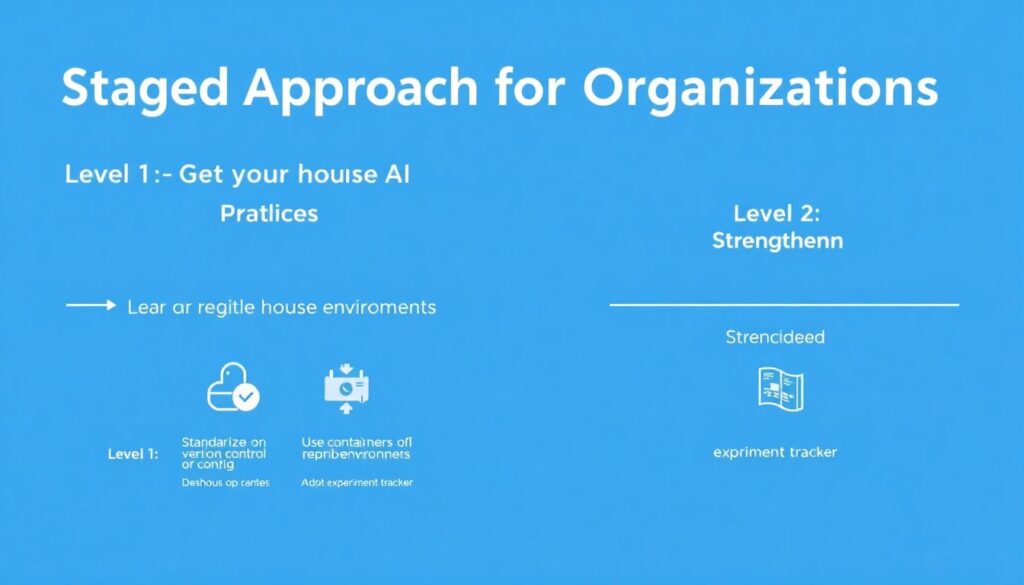
For organizations trying to decide how far to go, a staged approach tends to work best:
1. Level 1 – Get your house in order.
– Standardize on version control for all code and config.
– Use containers or reproducible environments.
– Adopt an experiment tracker, even a simple one.
2. Level 2 – Strengthen internal reproducibility.
– Introduce structured data versioning (DVC, LakeFS, etc.).
– Enforce documentation of datasets, preprocessing, and evaluation metrics.
– Run internal replication exercises for critical models.
3. Level 3 – Add tamper‑evident guarantees where it matters.
– For safety‑critical or regulated workflows, integrate a ledger-based anchoring service.
– Decide which events must be anchored (e.g., all pre‑registration of experiments, all models that go into production, or all published results).
– Choose between public chains, permissioned consortium chains, or specialized services, based on your compliance and governance needs.
Short close:
The goal isn’t to “use blockchain” for its own sake, but to align your reproducibility guarantees with the actual risk profile of your AI systems.
—
Where this is likely headed

Blockchain-enabled reproducible research with AI is still early, but the underlying forces pushing it — costly experiments, regulatory pressure, and cross‑institution collaboration — are gaining momentum. Traditional tools handle day‑to‑day reproducibility within trusted environments. Blockchains step in where trust is thin and verification matters: multi‑stakeholder science, public‑facing claims, and safety‑critical AI.
As these layers converge, the most effective systems will feel almost invisible to researchers: you run your experiment as usual, your tools quietly anchor the evidence, and years later, anyone who needs to check your work has the cryptographic breadcrumbs to follow. That’s the real promise behind the buzzwords.