
Why digital sovereignty suddenly matters so much
Digital sovereignty used to sound like a buzzword governments threw into strategy papers. Now it’s turning into a survival requirement. AI models are trained on global data, blockchains are increasingly embedded into critical infrastructure, and most of that stack still runs on a handful of hyperscalers and a few dominant AI vendors.
In other words, the “intelligence” and the “ledger of truth” of the digital world are often owned, hosted, or controlled by someone else. That’s exactly where AI‑empowered blockchain ecosystems come in: they let you separate *who runs the infrastructure* from *who owns the logic, data, and decisions*.
From “trust the cloud” to “trust the protocol”
AI + blockchain: why combine them at all?
Let’s be blunt: neither AI nor blockchain solves digital sovereignty alone.
– AI gives you powerful inference and automation, but usually concentrates power in whoever controls the model and the training data.
– Blockchains give you verifiable state and shared rules, but they’re terrible at privacy and don’t natively understand the semantics of data.
When you blend them correctly, you get something more interesting: a programmable trust layer where AI does the reasoning, while blockchain enforces who can do what, when, and under whose jurisdiction. That’s the missing piece for real data sovereignty.
A lot of enterprise blockchain solutions for digital sovereignty failed in the first wave because they copied public crypto networks but slapped on KYC and firewalls. The next wave is different: it treats sovereignty as a design goal, not as a legal afterthought.
Some hard numbers (that actually matter)
To see where this is going, it helps to anchor the hype in data:
– The global blockchain market is projected to exceed USD 125–150 billion by 2030, with enterprise and government use cases taking a growing share.
– AI spend is exploding faster: generative AI alone is forecast to surpass USD 1.3 trillion in annual revenue by 2032, with a significant slice tied to data infrastructure and security.
– IDC and others estimate that by 2027, over 65% of global GDP will be “digitally transformed” — meaning whoever controls the data pipelines and identity rails effectively shapes economic policy in practice, not just on paper.
Put together, that’s why the idea of a sovereign AI blockchain platform for governments isn’t just a research topic anymore; it’s an attempt to prevent critical decision logic from becoming de facto outsourced to foreign clouds and opaque models.
How digital sovereignty reshapes AI‑blockchain architectures
From data lakes to jurisdiction‑aware data meshes
Most AI pipelines today assume one big amorphous data pool. Sovereignty demands the opposite: lots of smaller, jurisdiction‑aware pools that can still act as one logical system.
The pattern that’s emerging looks like this:
1. Local data stays put. Health, tax, identity, defense, and critical infrastructure data are stored and processed in‑country or in‑region.
2. Global coordination is on‑chain. A governance layer, often a consortium blockchain, records policies, access grants, model versions, and key decisions.
3. AI agents move, not data. Instead of shipping raw data around, you send AI workloads (or model slices) to where the data lives, with attested execution and auditable outcomes.
Here, a secure Web3 infrastructure for data sovereignty isn’t about NFTs or DeFi; it’s about using cryptographic proofs, decentralized identifiers (DIDs), and verifiable credentials so that each jurisdiction can prove it followed its own rules *and* the joint rules of the consortium.
Private permissioned chains with AI brains
Classical permissioned ledgers solved control but ignored intelligence. Now you’re seeing architectures where a private permissioned blockchain with AI for data governance acts as a policy brain, not just a transaction log.
Concrete capabilities:
– Dynamic access control. Instead of static ACLs, AI models evaluate context: purpose of use, risk scoring, anomaly patterns, even geopolitical constraints. The blockchain stores the policy graph and all decisions as immutable events.
– On‑chain explainability. “Why did the model deny this cross‑border query?” becomes a queryable on‑chain record, not an email to an opaque ML team.
– Adaptive retention and localization. AI classifies data according to regulation (GDPR, local privacy acts, sectoral rules) and triggers local deletion, pseudonymization, or relocation, with the chain providing verifiable enforcement.
This is where AI-powered blockchain compliance solutions for enterprises become more than just marketing fluff: compliance rules turn into executable smart contract logic plus ML‑driven policy engines, producing cryptographic proofs instead of screenshots in PDFs.
Economic angles: who wins and who loses
Sovereign data = new asset class
Once data ownership is enforceable in code, it stops being a sunk cost and starts becoming a monetizable asset under clear terms.
For governments and large enterprises this changes the equation:
– Reduced regulatory risk. Fewer fines, less uncertainty in cross‑border collaboration. The EU alone has imposed billions of euros in data‑protection penalties in recent years; even a modest 20–30% risk reduction is economically massive.
– New licensing and revenue models. “Sovereign data pools” can license *derived insights* or *federated model updates* instead of raw data. That keeps political control while still joining global AI ecosystems.
– Lower switching costs. If access rights and policies are codified on a neutral ledger, migrating from one cloud or AI vendor to another becomes cheaper, which pressures incumbents and shifts bargaining power.
On the flip side, hyperscalers and centralized AI providers will see margin pressure where their value proposition is mostly “we host and control everything for you.” Sovereign infrastructures commoditize that layer and push value to governance, cryptography, and domain‑specific models.
Cost realism vs. sovereignty ambitions
There’s a catch: building sovereign AI‑blockchain stacks isn’t cheap. Specialized hardware, cryptographic expertise, regulatory coordination, and integration with legacy systems all add up.
However, two trends tilt the math:
1. Shared sovereign platforms. Regional alliances (e.g., groups of countries or industry consortia) can co‑fund core infrastructure, amortizing CapEx while preserving local control through on‑chain governance.
2. Progressive decentralization. Start centralized with strict auditability, then gradually move to more decentralized validators and AI agents as trust and capability mature. This avoids “big‑bang” infrastructure projects that often fail.
Net‑net, the total cost of ownership may still be lower over 5–10 years than staying locked into a small vendor set and paying for bespoke compliance patches every time the law changes.
Industry impact: beyond finance and crypto
Regulated industries become Web3 natives (quietly)
Sectors that historically hated public blockchains — banking, healthcare, utilities — are quietly adopting hybrid patterns:
– Banking. Transaction data stays within domestic banking consortia, but KYC/AML checks, model‑driven risk scoring, and cross‑border settlement rules live on a shared ledger. AI agents handle sanction checks and fraud patterns and write signed conclusions on‑chain.
– Healthcare. Patient records remain in hospital or national systems. Research AIs submit computation requests, execute locally via trusted execution environments, and only share aggregated statistics or model updates recorded on the blockchain for traceability.
– Energy and critical infrastructure. Grid telemetry, maintenance logs, and IoT sensor data are governed by AI policies encoded in consortium chains so that foreign operators or vendors cannot unilaterally change how data flows.
In all of these, Web3 is not about tokens; it’s the governance substrate that defines who gets to run what AI where, and under which sovereign rules.
Governments as protocol participants
When states adopt a sovereign AI blockchain platform for governments, they effectively become full participants in the protocol, not just regulators watching from the outside.
Striking implications:
– Laws as code, not just PDFs. Certain regulatory constraints (e.g., “tax data must not leave jurisdiction X unless conditions Y and Z are met”) become smart contracts enforced automatically, with AI helping evaluate the conditions.
– Programmable treaties. Multi‑state agreements about data‑sharing or joint AI models can be encoded as cross‑chain bridges and shared governance contracts. Amendments become protocol upgrades, with clear and auditable history.
– Civic transparency. Citizens can verify that their data was used only under declared policies, without exposing the content of that data, using zero‑knowledge proofs anchored on‑chain.
This flips the classic model where citizens and companies have to trust that ministries follow internal procedures. Instead, the procedure itself becomes a shared, verifiable machine‑readable artifact.
Non‑obvious, slightly unconventional directions
Idea 1: “Personal Data Unions” as sovereign micro‑states
One radical but feasible concept: treat groups of citizens or companies as *micro‑sovereign entities* that negotiate as a block.
Imagine this flow:
1. Individuals join a “data union” organized around a city, a profession, or a disease group.
2. The union issues a collective data license encoded on a consortium chain, describing how aggregated data can be used for training or analytics.
3. AI agents represent the union in negotiations with pharma companies, research institutions, or insurers, dynamically adjusting price and conditions based on demand, risk, and member votes.
4. Revenues or benefits flow back to members as rewards, premium services, or better insurance terms.
Digital sovereignty here is not just national; it’s collective bargaining for data at smaller scales, with blockchains ensuring transparent accounting and AI handling the game‑theory and pricing complexity.
Idea 2: Adversarial “sovereignty testing” AIs

Today, we pen‑test security but almost nobody “stress‑tests” sovereignty policies. That’s an obvious gap.
Non‑standard solution: deploy adversarial AI agents whose job is to *break* your data‑sovereignty guarantees (within a sandbox). They try to:
– Infer sensitive attributes from allowed outputs.
– Craft model queries that cause information to leak across jurisdictions.
– Abuse timing, metadata, and correlation between separate data sets.
– Exploit misconfigurations in cross‑border access policies.
Every successful attack is recorded as a governance event on the blockchain, triggering mandatory remediation and policy updates. Over time, you maintain a living proof that your sovereign guarantees have survived continuous, AI‑driven red‑teaming.
Idea 3: “Jurisdiction‑shifting” AI workloads
Another unconventional approach: instead of pinning an AI service to one legal realm, you let it *move* across jurisdictions, like a digital ship re‑flagging — but under strict, transparent rules.
Example:
– An AI analytics service declares it can operate under Regulation Set A (EU‑style), B (US‑style), or C (local).
– Its current “flag” is recorded on‑chain. Every time it shifts to another regulatory regime (e.g., to process US data on a US node), a chain transaction updates the state, and constraints for that session are switched accordingly.
– Users or organizations can restrict interaction only to certain flags, and audits can prove under which regime each decision was made.
This might sound exotic, yet it’s a pragmatic way to deal with multi‑jurisdiction operations without duplicating entire stacks per country.
What to build today (if you don’t want to wait for 2030)
Practical starting moves
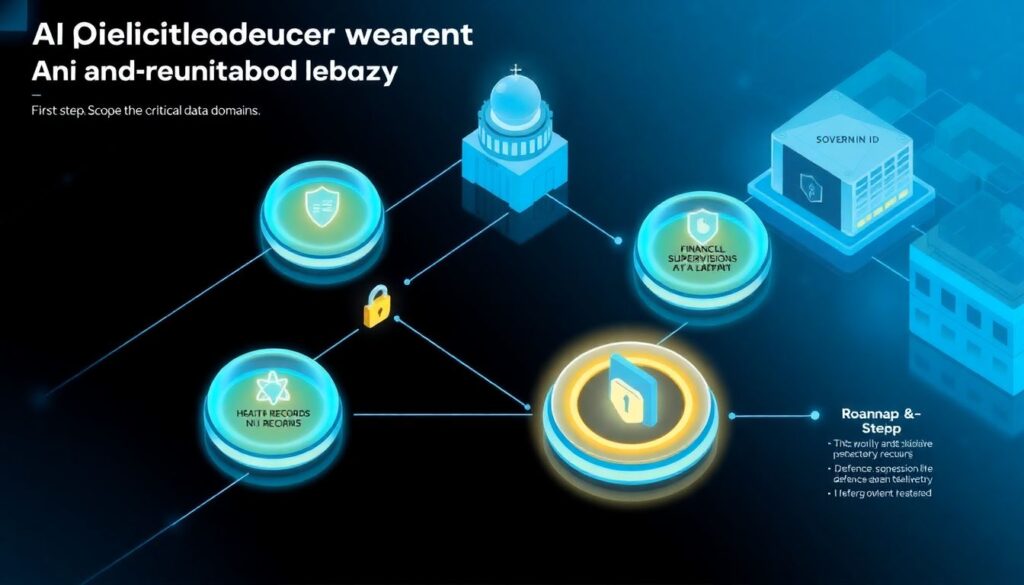
You don’t need a national‑scale rollout to start moving towards digital sovereignty in AI‑blockchain ecosystems. A reasonable roadmap could be:
1. Scope the critical data domains. Identify which datasets are sovereignty‑sensitive: citizen ID, health, financial supervision, defense‑adjacent telemetry, industrial IP.
2. Introduce verifiable identities. Deploy DIDs and verifiable credentials for organizations, services, and even models. Trusting endpoints blindly is the fastest way to lose sovereignty.
3. Pilot a narrow, high‑value use case. For example: cross‑border tax data sharing, AI‑assisted compliance in trade finance, or federated health research. Make sure governance events and model decisions are anchored on a consortium chain.
4. Integrate AI into policy, not just analytics. Use ML to evaluate policy conditions dynamically — risk, purpose, behavior anomalies — but keep final enforcement and logging on the ledger.
5. Design for exit. Whatever you build, ensure you can replace the AI vendor or cloud provider without losing identity, history, or control. That’s the practical core of digital sovereignty.
Looking ahead
By the early 2030s, the plausible end‑state is a globally networked patchwork of sovereign AI‑blockchain ecosystems: interoperable, but not centrally controlled. Data doesn’t freely flow; *rights to compute* on data flow, under cryptographic proofs and machine‑readable laws.
If we get the architecture right, digital sovereignty won’t mean isolation or technological nationalism. It will mean that participation in global AI systems is *voluntary, revocable, and accountable* — with blockchains providing the memory and AI providing the adaptive intelligence to keep up with a messy, fast‑changing world.