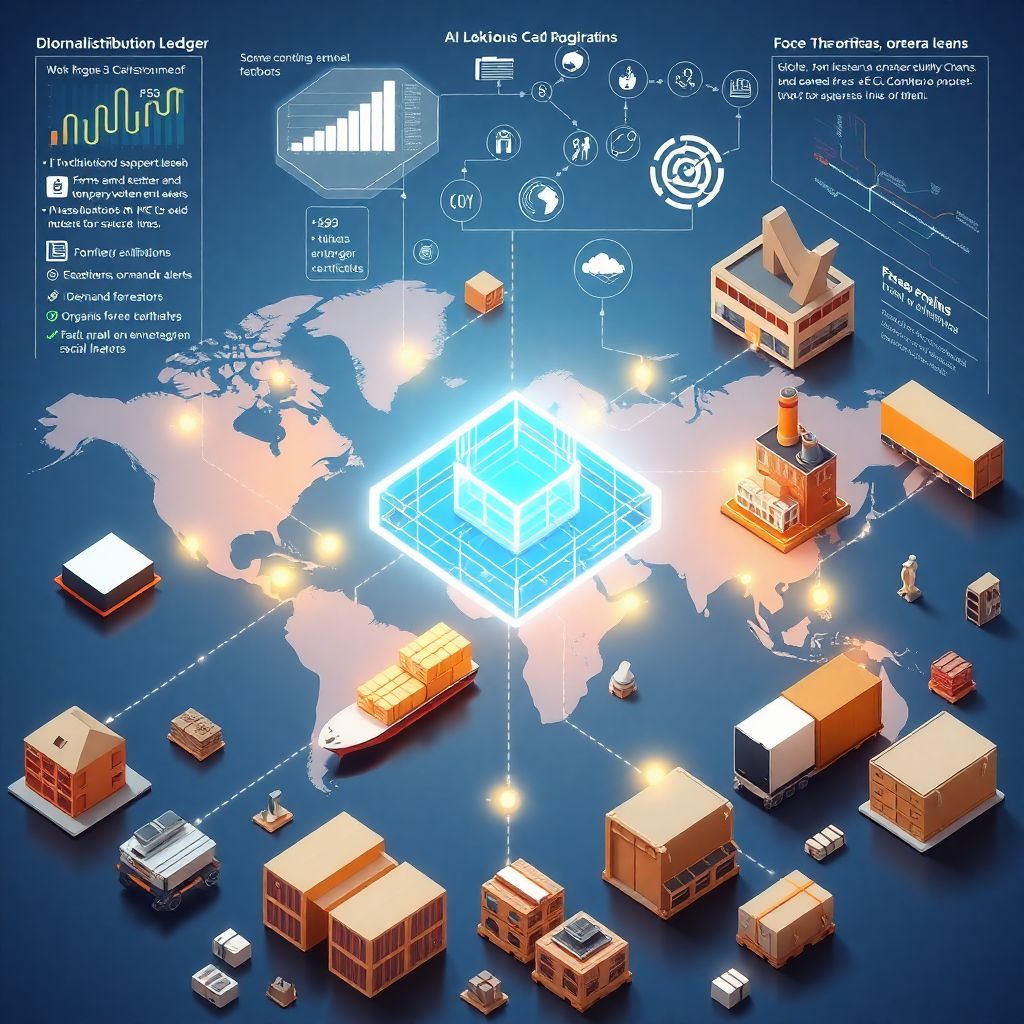
Why AI + Blockchain Landed in Supply Chains
Короткая история длинных цепочек поставок
Back in the 1990s, “digital supply chain” meant EDI messages, barcodes and a lot of fax machines. In the 2000s ERP and WMS systems became the norm, but data still lived in silos and spreadsheets. Around 2015, blockchain hype kicked in: everyone promised transparent logistics, but most pilots stayed in PowerPoint because networks were hard to govern and performance was weak. By the early 2020s, AI finally matured: demand forecasting, anomaly detection, dynamic routing — all became practical. By 2025, combining these two stacks stopped being a buzzword and turned into production‑grade AI‑enhanced blockchain supply chain solutions for companies that need real-time visibility and verifiable sustainability data.
Почему устойчивость стала триггером
The actual catalyst wasn’t just efficiency; it was regulation and consumer pressure. ESG reporting rules in the EU, Scope 3 emissions accounting and forced-labor bans pushed companies to prove what happens not only in their own factories but across farms, mines and subcontractors. Classic databases were too easy to “adjust” under pressure, while audits were slow and expensive. A tamper‑evident ledger plus models that can flag suspicious patterns offers a more scalable way to trust your numbers. That’s where an ai blockchain platform for supply chain scenarios started to look like infrastructure rather than yet another IT experiment.
—
Core Concepts: What “AI-Enhanced Blockchain” Actually Means
Блокчейн-слой: источник правды
Think of the blockchain layer as a shared logbook for all supply chain events: purchase orders, shipment scans, certificates, IoT sensor readings. It doesn’t have to be a public chain; in fact, most industrial deployments use consortium or permissioned networks to keep latency predictable and data access controlled. Smart contracts encode business rules: when a batch leaves a farm, changes ownership, gets processed or fails a quality check, a corresponding transaction updates its status. This provides the immutable data foundation that sustainable supply chain management software has been missing for years.
AI-слой: мозг над журналом
AI sits on top of that verified data and does the heavy analytical lifting. It can clean noisy inputs, infer missing attributes, cluster suppliers by risk and run forecasts based on historical flows anchored on‑chain. Instead of reading the blockchain directly, AI models usually connect to off‑chain data lakes that mirror on‑chain events in a query‑friendly form. This ai powered supply chain optimization platform then feeds insights back into smart contracts or operational dashboards: routing proposals, dynamic safety stock, CO₂ hot‑spot detection, or early warnings on likely labor or compliance issues.
—
Step-by-Step: Designing an AI-Blockchain Architecture
Шаг 1. Определите бизнес-кейсы, а не технологии
Before picking chains, nodes and models, pin down 2–3 narrow but painful problems. Examples: trace cocoa beans from cooperative to chocolate bar to answer NGO claims, track cobalt from mine to battery to handle EU battery regulation, or synchronize emissions data across dozens of small suppliers. For each case, describe in plain language what needs to be immutable, who must read or write data and what decisions AI should automate or propose. Without this, you’ll end up with a toy demo instead of production‑grade blockchain supply chain solutions that operations teams actually use.
Шаг 2. Спроектируйте модель данных и идентификаторы
Next, build a robust data model: products, lots, locations, parties, certificates, and events. Decide how you’ll identify a “unit” of traceability: batch, pallet, container, or even individual item for high‑value goods. Link physical IDs (QR, RFID, NFC, serials) with digital twins on‑chain. Think through splits and merges — when one batch feeds many SKUs, or many farms feed one silo. Poor modeling here leads to “traceability gaps” later that no AI can magically fix. At this stage, also decide what stays fully on‑chain and what is hashed on‑chain with raw data stored in off‑chain storage.
Шаг 3. Выбор блокчейна и сетевой модели
Now choose the ledger and governance model. For cross‑company process orchestration, permissioned frameworks are common, because they offer fine‑grained access control and predictable throughput. You’ll need to define who runs validator nodes, how new members join, what consensus is used and how you handle key management. Don’t underestimate the political aspect: procurement, legal and IT security must all sign off. The goal is not maximal decentralization at any cost, but enough distribution so no single actor can silently rewrite history, especially for critical ESG and compliance‑relevant data.
Шаг 4. Проектирование AI-стека

On the AI side, start with data engineering. Set up pipelines that stream events from the ledger and legacy systems into a centralized data platform with quality checks, schema validation and enrichment. Only after this should you choose models: classical time‑series for demand, gradient boosting or deep learning for risk scoring, NLP for reading certificates and audit reports. Keep the first wave explainable: operations managers and auditors must understand why a supplier was flagged. Later you can add more advanced models once trust in the overall pipeline is established.
—
Traceability and ESG: Where Blockchain Really Helps
От бумажных сертификатов к криптографическим доказательствам
Historically, traceability was a patchwork of paper certificates, PDFs and emails scattered across continents. Audits happened once a year, and the rest of the time you simply hoped nothing serious was going on. With blockchain traceability tools for ESG compliance, each certificate, lab test or inspection becomes a signed digital asset linked to actual shipments and supplier identities. AI models can then cross‑check inconsistencies, like an organic certificate attached to volumes that exceed a farm’s plausible yield, or a supplier in a high‑risk region suddenly increasing output without corresponding workforce data.
Мониторинг выбросов и социальных рисков
Sustainability reporting in 2025 is mostly about Scope 3 emissions and social impact in deeper tiers. To get credible numbers, you need granular data: energy mixes, transportation modes, process efficiencies, as well as labor conditions indicators. On‑chain anchoring ensures that once a supplier publishes emission factors or wage statistics, they cannot quietly backdate corrections to match internal targets. AI then aggregates and normalizes this mosaic into company‑level KPIs, highlighting hotspots where additional audits or supplier engagement is needed to keep your ESG narrative aligned with measurable reality.
—
Typical Mistakes When Building AI-Blockchain Supply Chains
Ошибка 1. Ставка на «магический» PoC
A frequent misstep is betting everything on a flashy three‑month proof of concept with a tech vendor and no real operational integration. The demo works in isolation, but it doesn’t touch procurement systems, doesn’t talk to carriers and ignores small suppliers with weak connectivity. When you later try to scale, you discover governance gaps, inconsistent identifiers and missing edge cases. Sustainable solutions require boring work: process mapping, contractual clauses for data sharing and long‑term funding for network operation, not just innovation‑lab budgets and keynote‑ready prototypes.
Ошибка 2. «AI все разберет сам»
Another trap is assuming AI will clean any mess. If suppliers upload photos, PDFs and spreadsheets without structure, models may produce something, but you’ll get fragile automation that breaks on every exception. AI thrives on consistent semantics: defined schemas for events, controlled vocabularies for product categories and location hierarchies. Invest early in data contracts and validation at the point of capture. Otherwise, you risk training sophisticated models on noisy, biased data that encode today’s blind spots instead of revealing them and supporting more sustainable business decisions.
Ошибка 3. Игнорирование человеческого фактора
Teams often underestimate how much change management is needed. Warehouse staff must scan codes correctly, procurement needs to push suppliers onto the network, and sustainability teams must trust new dashboards over old Excel templates. If incentives and training aren’t aligned, people will bypass the system whenever it feels slower than email. A technically elegant architecture without user adoption remains a sunk cost. Bake in user feedback loops, clear roles and metrics tied to real benefits: fewer disputes, faster recalls, or more favorable financing linked to verified ESG performance.
—
Practical Tips for Beginners
С чего начать безопасно и без боли

If you’re just entering this space, resist the urge to “boil the ocean”. Start with one product line and a limited geography, ideally where you already have engaged suppliers. Pick use cases with clear ROI: recall readiness, premium branding based on proven origin, or automated compliance reporting. Partner with vendors that can offer modular sustainable supply chain management software rather than monolithic suites. Make sure they support open standards and APIs so you can switch components later without rewriting everything. And always plan for gradual onboarding of smaller partners with limited IT resources.
Минимальный стек технологий для старта
At a basic level, you’ll need: a permissioned ledger or managed blockchain service, identity and access management, a data platform for off‑chain storage, and at least a lightweight analytics layer. Many companies use an ai blockchain platform for supply chain scenarios as a managed service to avoid building everything from scratch. For AI, start with pre‑built models and simple heuristics before jumping into custom deep learning. Over time, you can evolve toward a fully fledged ai powered supply chain optimization platform that integrates planning, logistics and sustainability analytics into a unified control tower.
- Prioritize data quality and clear identifiers before advanced AI features.
- Design governance (who can write, read, audit) as carefully as smart contracts.
- Align incentives so suppliers and internal teams actually benefit from participation.
—
Operationalizing and Scaling the Solution
Интеграция с существующими системами
Real impact only appears when blockchain and AI stop being side projects and plug into ERP, TMS, WMS and procurement tools. That means mapping master data, synchronizing status codes and handling error cases where one system is down or reports conflicting states. Event‑driven architectures help: whenever an on‑chain event occurs, integration services update legacy systems and vice versa. This reduces double data entry and ensures that users keep working in familiar interfaces while the new infrastructure quietly adds traceability, analytics and compliance assurances in the background.
Метрики успеха и постоянное улучшение
To keep sponsors on board, define measurable KPIs early. Examples include time to investigate a recall, percentage of shipments with full provenance, accuracy of demand forecasts, or reduction in manual ESG reporting effort. Monitor these monthly and feed the results back into backlog prioritization: sometimes a small UX fix in a scanning app brings more benefit than a new model architecture. AI components should also be monitored for drift: when supplier behavior or regulations change, retrain models and update rules so the system doesn’t silently degrade or misclassify emerging risks.
- Track both technical metrics (latency, node uptime, model accuracy) and business outcomes.
- Schedule regular model and smart contract reviews with cross‑functional teams.
- Document design decisions so future teams understand the rationale behind trade‑offs.
—
Looking Ahead: The 2025–2030 Horizon
От разрозненных сетей к интероперабельной экосистеме
As of 2025, we still see many fragmented pilots: food here, batteries there, textiles elsewhere. Over the next five years, the real challenge is interoperability: making different ledgers and data models talk to each other so that a battery’s cobalt story survives as it moves from mining chain to manufacturing chain to recycling chain. Standards for product passports and verifiable credentials are emerging, and AI will play a crucial role in reconciling slightly different schemas while preserving cryptographic guarantees. The long‑term vision is a mesh of connected, machine‑readable supply networks.
Финансирование и регуляторы как драйверы изменений
An underappreciated accelerator is green and sustainability‑linked finance. Banks and investors increasingly demand hard evidence of ESG claims, not just glossy reports. Systems combining blockchain’s tamper‑evident histories with AI analytics offer exactly that, turning verified performance into better credit terms or preferred‑supplier status. Regulators, too, are moving from voluntary disclosure to mandatory digital reporting. Companies that master these tools early gain not only reputational benefits but also operational resilience, because they actually know what happens deep in their supply chains instead of relying on assumptions and outdated paper trails.