
Automated finance in crypto has gone from side project to serious competitor to banks in just a few years. We’re no longer talking about a handful of geeks in Discord; we’re talking about systems that move tens of billions of dollars without branches, call‑centers or loan officers.
Below — a structured, but conversational look at how that’s happening, what the numbers say, and where this could realistically go.
—
DeFi as an alternative financial operating system
Масштаб: от эксперимента к инфраструктуре
If we strip away the buzzwords, DeFi is just automated finance running on blockchains: code replaces back‑office staff, smart contracts replace legal agreements, and tokens replace balance‑sheet entries.
By late 2021 the total value locked (TVL) in DeFi passed $180–200 billion during the peak cycle; after the 2022–2023 downturn it fluctuated roughly in the $40–80 billion range, depending on market conditions. Even at these “bear market” levels, this is comparable to the balance sheet of a mid‑size European bank — but built mostly by open‑source teams in a few years.
Daily stablecoin settlement on public chains regularly hits tens of billions of dollars. On some days, major networks process more dollar‑denominated value than many card networks in smaller countries. That’s not hobbyist scale anymore.
Short version: defi protocols replacing traditional banks is no longer a hypothetical future; in some niches — like 24/7 FX swaps or collateralized crypto lending — the replacement is already happening quietly in the background.
Почему автоматизация здесь действительно радикальна
Banks automate too, of course. The difference is *who* controls the automation.
In DeFi:
– The rules are encoded in smart contracts, visible and auditable on‑chain.
– Access is permissionless: if you have an internet connection and a wallet, you can participate.
– Settlement is final within minutes, not days.
This flips the traditional model. Instead of “trusted institution + opaque software,” you get “transparent software + minimized trust in institutions.” That’s a deep structural change, not just a new app interface.
—
Экономика доходности: от депозитов к on‑chain стратегиям
Как формируется доход в мире DeFi
When people ask how to earn yield with decentralized finance, they often expect some magic formula. In practice, most sustainable returns in DeFi come from quite familiar sources:
1. Trading fees — providing liquidity to automated market makers (AMMs) like Uniswap and Curve.
2. Interest spreads — supplying capital to lending pools and earning variable rates from borrowers.
3. Liquidation incentives — earning fees when under‑collateralized positions are liquidated.
4. Arbitrage and MEV — more advanced, but powerful for professionals.
Unlike bank deposits, there’s no state‑backed deposit insurance, and no central bank acting as lender of last resort. The yield isn’t “free”; it is the direct compensation for taking carefully defined smart‑contract, market, and protocol‑level risks.
Лидеры и нестандартные ходы в кредитовании
The best defi lending protocols for passive income — think Aave, Compound, Maker, and newer specialized platforms — operate more like autonomous money markets than like banks.
They allow:
1. Deposit of assets into a shared pool.
2. Over‑collateralized borrowing against that pool.
3. Algorithmic adjustment of interest rates based on supply and demand.
A non‑obvious strategy here is *cross‑protocol capital choreography*:
Instead of just “deposit and forget,” advanced users and automated finance platforms for crypto investing dynamically move liquidity between lending pools, AMMs and derivatives protocols, chasing not only the highest yield, but the *most efficient risk‑adjusted* yield.
In other words, the “high‑net‑worth client with a private banker” is being replaced by smart contract vaults that constantly rebalance positions on‑chain.
—
Статистика и прогнозы развития DeFi
Что говорят текущие цифры
Consider a simplified snapshot of major DeFi indicators over the last few years:
– Users: On‑chain data suggests that unique addresses interacting with DeFi contracts are in the low millions. Adjust for bots and multiple wallets, and you likely end up with hundreds of thousands of genuinely active participants.
– Stablecoins: Circulating supply of major USD stablecoins has hovered around the $120–150 billion mark in recent cycles, much of which flows through DeFi rails.
– Protocol revenue: Leading protocols have collectively generated billions of dollars in fees for liquidity providers, token holders, and treasuries.
In traditional terms, this looks like a small but rapidly growing “shadow financial system” with real revenues, not just speculative token emissions.
Куда это может прийти через 5–10 лет
Forecasts obviously depend on regulation, macro conditions, and technological progress, but some trajectories are reasonable:
1. Institutional DeFi adoption: enterprise defi solutions for traditional financial institutions are already piloted by global banks experimenting with tokenized deposits, repo, and on‑chain collateral management. Over the next decade, expect tier‑one banks to run internal DeFi‑like rails for wholesale operations while clients still see familiar interfaces.
2. Tokenized real‑world assets (RWA): Bonds, treasuries, even invoices and carbon credits are gradually moving on‑chain. If even 5–10% of global bond markets become tokenized and partially routed through DeFi infrastructure, TVL could move from tens to hundreds of billions again — this time with more stable, real‑world collateral.
3. Regulated on‑chain money markets: Instead of trying to clone banks, DeFi may evolve into the global back‑end for regulated front‑ends. Users interact with compliant wallets and neobanks, but under the hood, liquidity and risk management run via smart contracts.
Notably, in most realistic scenarios DeFi doesn’t kill banks; it rewires them. The economic power shifts from static balance sheets to dynamic, interoperable liquidity networks.
—
Экономические аспекты: стоимость капитала и эффективность
Почему DeFi меняет цену риска
Traditional banking relies on a layered structure of costs: branches, compliance, legacy IT, capital requirements, and human decision‑making.
DeFi:
– Removes most branch and staffing costs.
– Reduces IT overhead by using shared infrastructure (public blockchains).
– Automates large parts of compliance logic on‑chain (though not the legal obligations themselves).
The result is that the *all‑in cost* of running a lending or trading venue can be significantly lower on‑chain. This doesn’t always show up as cheaper loans for consumers yet — partly because of crypto volatility premia — but over time, as tokenized real‑world collateral becomes normal, competition on transparent markets should compress spreads.
Вторичный эффект: финансовая модульность
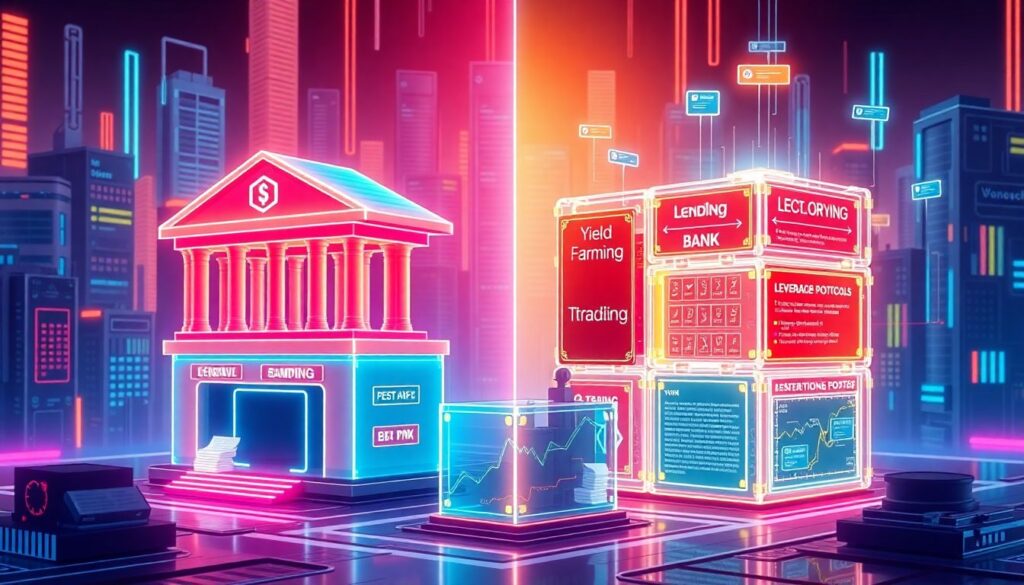
An under‑appreciated economic effect of DeFi is modularity.
In banking, building a new product often requires internal approval, IT integration, and balance‑sheet allocation. In DeFi, you can treat each protocol as a “money Lego”:
1. Take a lending protocol for leveraged positions.
2. Combine it with an AMM to gain exposure to specific assets.
3. Add an options or insurance protocol to hedge risk.
This *composability* significantly lowers innovation costs. A small team can stitch together three existing protocols and launch a new product in weeks instead of years — and if it works, capital can pour in permissionlessly from all over the world.
Economically, this looks more like a global open‑source derivatives desk than a single institution.
—
Влияние на индустрию: от фронт‑офиса до бек‑энда
Банки: конкуренция или симбиоз?
It’s tempting to frame this as a war: defi protocols replacing traditional banks vs. banks defending their territory. Reality is messier and more interesting.
Banks have three assets DeFi doesn’t:
1. Regulated access to fiat rails.
2. Existing customer trust (or at least familiarity).
3. Political and regulatory relationships.
DeFi has three assets banks struggle with:
1. Faster innovation cycles.
2. Global, 24/7 reach without branches.
3. Radical transparency of reserves and risk.
The likely outcome is *domain specialization*:
– Retail savings and day‑to‑day payments might remain largely bank‑centric, but use tokenized deposits and stablecoins under the hood.
– Treasury, FX, and collateral operations for institutions increasingly move to programmable, on‑chain infrastructure to reduce friction and settlement risk.
– High‑risk, high‑yield strategies and experimental instruments stay on the DeFi frontier.
The “bank vs protocol” debate then becomes a question of which layer controls the user relationship and which layer is commoditized into infrastructure.
Регуляторы и нестандартные подходы к надзору
Regulators face a dilemma: applying legacy rules one‑to‑one often doesn’t fit systems where there is no central operator. Blanket bans push activity offshore; unregulated free‑for‑all invites systemic risk.
A non‑standard, but promising path is regulating interfaces and risk parameters, not code per se:
1. Identify critical protocols as “public financial infrastructure,” similar to clearing houses.
2. Require rigorous security audits, open‑source code, and transparent governance — but don’t demand a single corporate controller.
3. Regulate front‑end providers (wallets, exchanges, neobanks) on KYC/AML, disclosures, and suitability, while letting the underlying protocols remain permissionless.
This keeps the innovation engine running while giving regulators meaningful levers for consumer protection and systemic stability.
—
Нестандартные решения и будущие сценарии
Идея 1: DAO‑банкинг для малых и средних предприятий
Small and medium businesses (SMEs) are chronically under‑served: banks find them too risky and costly to underwrite individually. DeFi could flip that with DAO‑based credit unions:
1. SMEs in a sector pool data (cashflows, invoices, on‑chain payment history).
2. A sector‑specific DAO uses that data and on‑chain analytics to create shared risk models.
3. Lending protocols plug into these DAOs, pricing credit with sector‑level insights rather than generic collateral ratios.
This doesn’t fully remove risk, but it replaces opaque manual underwriting with transparent, collectively governed models. For SMEs, it could mean faster access to working capital at more predictable rates.
Идея 2: On‑chain “savings accounts” with embedded safety rails
DeFi right now is unforgiving: misclicks, bad contracts, and leverage can wipe you out. A practical, slightly contrarian move would be safety‑first vaults:
– Capital is only allocated to battle‑tested, high‑liquidity protocols with clean security records.
– A built‑in risk budget caps maximum loss over a given period, enforced by smart contracts.
– Users see a familiar “savings” interface, but the back‑end dynamically allocates between stablecoin lending, low‑volatility liquidity pools, and tokenized short‑term treasuries.
This is where automated finance platforms for crypto investing could really shine: not in chasing the absolute highest APY, but in offering transparent, rule‑based, conservative yield strategies that regular users can understand.
Идея 3: Гибридные государственно‑частные платформы

Instead of building central bank digital currencies (CBDCs) entirely in‑house, governments could define standards and let ecosystems compete:
1. The central bank issues a base digital currency, redeemable 1:1 for fiat.
2. Licensed providers build DeFi‑compatible layers on top — lending markets, FX, cross‑border settlement — using open standards.
3. Consumers interact with efficient, competing products, while systemic risk is anchored by the central bank layer.
This hybrid model combines state‑backed settlement finality with market‑driven innovation, creating a bridge between on‑chain protocols and mainstream finance without forcing everyone into a single monolithic CBDC app.
—
Заключение: перезагрузка финансовой логики
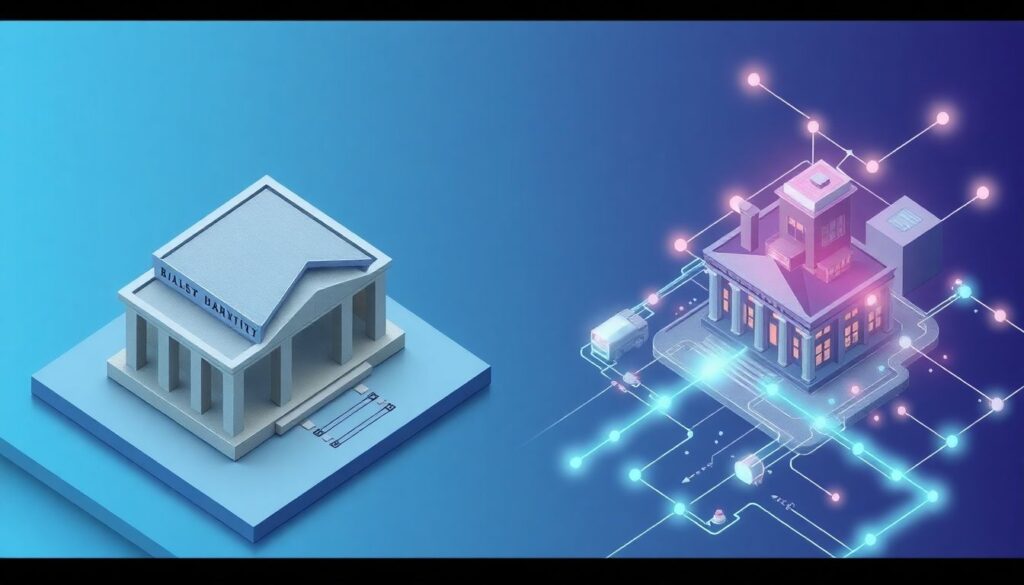
If you zoom out, DeFi is less about “crypto toys” and more about rewriting financial logic around software, not institutions.
Instead of a world where each bank is a silo with its own rails, fee schedule, and opaque risk models, we’re slowly drifting toward a network where:
1. Core financial functions — lending, trading, collateral, settlement — run as open, composable protocols.
2. Risk and reward are transparent, priced in real time by global markets.
3. Banks, fintechs, and new players plug into the same programmable liquidity layer, competing mostly on UX, regulation, and niche expertise.
Whether this ends in full‑scale defi protocols replacing traditional banks, or in a more nuanced merger where banks become branded shells over decentralized infrastructure, is still open. But the direction of travel is clear: automation, transparency, and global access are becoming the defaults, not the exceptions.