
Why tokenized funds can’t ignore blockchain-powered compliance
Tokenized funds are no longer a side project for a couple of crypto enthusiasts. They are steadily moving into the toolbox of traditional asset managers, family offices and even regulated banks. But as soon as you start issuing digital fund shares on-chain, one problem shows up immediately: how to stay fully compliant without drowning in manual checks, spreadsheets and late-night legal reviews. That is exactly where blockchain-powered compliance automation steps in, giving you a way to embed rules directly into code while still satisfying regulators. Instead of treating compliance as an afterthought, you design it right into the lifecycle of the tokens — from investor onboarding to secondary market transfers and redemptions.
Key tools you’ll need to automate compliance for tokenized funds
Before getting into the step-by-step process, it helps to know which building blocks you actually need. Think of this not as buying a single “magic platform”, but as assembling a toolkit. For most managers, the heart of the stack is tokenized funds regulatory compliance software that talks to both on-chain infrastructure and off-chain registries. Around it, you add modules for identity checks, risk scoring, reporting and governance. When this toolkit is properly wired together, you get blockchain compliance solutions for asset managers that feel like a modern operating system instead of a patchwork of legacy tools and manual email-based workflows.
1. Smart contracts for fund tokens and compliance logic
At the core of any tokenized fund is a smart contract that represents the fund shares themselves. But if you want automated regulatory compliance for tokenized funds, the token contract needs more than simple mint and transfer functions. It should understand who is allowed to buy, hold and trade units based on jurisdiction, investor category and risk profile. Technically, this often means using upgradeable smart contracts with built‑in transfer restrictions, whitelists, role-based access control and the ability to “pause” transfers in case of regulatory changes. Instead of writing hundreds of pages of distribution agreements, you encode a good part of those rules straight into the token logic.
2. Blockchain KYC/AML platform and identity layer

Compliance automation is impossible if you treat identity verification as a disconnected, offline process. A modern blockchain KYC AML platform for investment funds does more than collect passports and utility bills; it issues a cryptographic proof that a given wallet address belongs to an investor who passed KYC, AML and, if needed, suitability checks. In practice, this usually involves a regulated KYC provider that verifies the user, creates a compliance profile and links one or more blockchain addresses to that profile. The smart contract doesn’t see sensitive data — it just sees that address X is allowed to hold share class Y in jurisdiction Z, which keeps you compliant while respecting privacy constraints and data-protection rules.
3. Oracles, registries and integration with off-chain systems
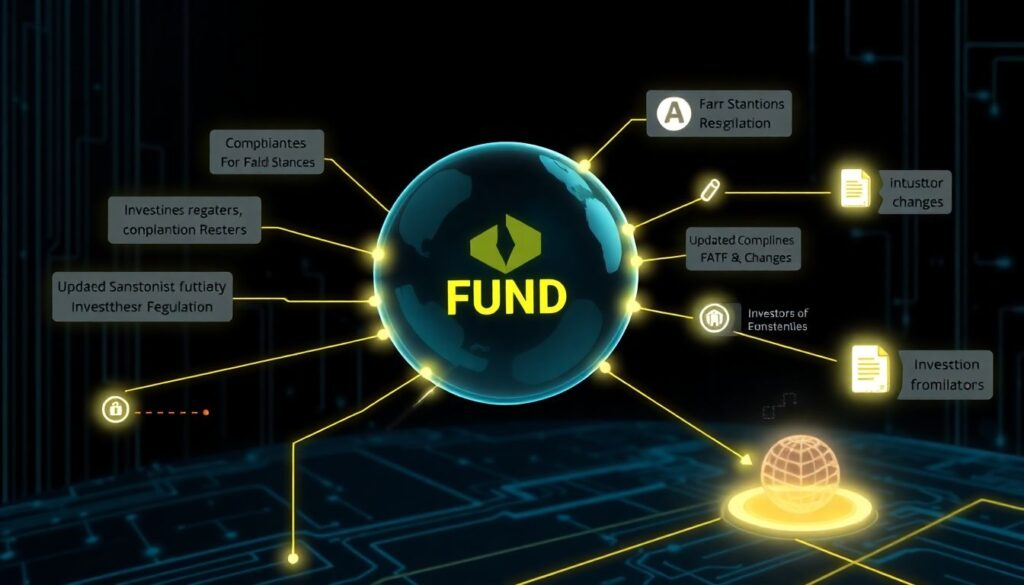
Because regulations change, sanctions lists get updated and investors move between jurisdictions, your fund can’t live entirely in an on-chain bubble. You need reliable connections to the outside world. Oracles and off-chain registries feed updated compliance data into your contracts: think new FATF lists, updated risk scores, revised investor categorization or new tax requirements. This is also where blockchain-based fund administration and compliance services plug in: they synchronize on-chain holdings with your fund administrator’s records, transfer agents, banking partners and auditors. Done right, everyone looks at the same source of truth, with far fewer reconciliation errors and late-night spreadsheet marathons.
4. Dashboards, alerts and audit-ready reporting
The last major tool is a monitoring and reporting layer that surfaces what is going on under the hood. You want dashboards that show investor activity, transfer attempts blocked for compliance reasons, KYC status by region and any unusual behavior that might trigger an investigation. Many providers now bundle this with automated regulatory filings, suspicious activity reports and investor notices. For asset managers, this is where blockchain compliance solutions for asset managers really start to feel tangible: you don’t just comply; you can show regulators, auditors and internal risk committees exactly how each rule is enforced and when exceptions happened, with cryptographic proof.
Step-by-step process for implementing compliance automation
Implementing automated regulatory compliance for tokenized funds is a project, not a toggle you flip overnight. But it becomes much less intimidating if you break it into clear stages. Below is a practical roadmap based on how real managers are doing it today. The goal isn’t to chase every new token standard but to reach a point where issuing and managing a compliant, tokenized share class feels as routine as launching a traditional sub-fund, just with far fewer intermediaries and a lot more transparency built in from the start.
Step 1: Map your regulatory obligations into concrete rules
Start by translating the dense legal texts into specific yes/no questions and data points. Which jurisdictions can you market to? Do you allow only professional investors, or can retail investors participate under local exemptions? Are there limits on concentration, lock-up periods or investor types (e.g., ERISA, UCITS, QIBs)? Sit down with legal, compliance and your fund administrator to produce a machine-readable rule set: allowed countries, investor categories, maximum holdings, blacklisted entities, plus any special treatment for employees or strategic partners. This is the rulebook your token and compliance engine will later enforce programmatically, so investing time here saves you headaches later.
Step 2: Design the token structure and permission model
Once rules are clear, design the token itself. Decide on the network (e.g., Ethereum, Polygon, a permissioned chain), the token standard (ERC‑20 with transfer hooks or a more specialized security‑token standard) and how you’ll handle permissioning. Many managers opt for a two-layer model: a core token contract and an external compliance module that approves or rejects transfers based on investor status. This design lets you update compliance logic without forcing a total migration of tokens. During this phase, you also define operational roles: who can whitelist investors, who can freeze tokens, who can update jurisdiction settings, and who signs off on any upgrade of the contracts.
Step 3: Connect your KYC/AML process to wallets and smart contracts
Next, integrate identity verification. Investors go through onboarding via your blockchain KYC AML platform for investment funds, digitally submitting documents and answering suitability questions. Once approved, they are mapped to one or more wallet addresses. The onboarding platform then updates your compliance registry on-chain or in a connected database so that any time a transfer is requested, the system checks whether both sender and recipient are authorized. A common pattern is to use a “registry contract” that stores only anonymous flags — like jurisdiction code, investor type and risk category — while sensitive details stay off-chain with the KYC provider, meeting privacy laws but still enabling automated checks at transaction time.
Step 4: Issue the tokenized fund shares and onboard initial investors
With the infrastructure ready, you can mint the initial supply of tokenized fund units and start onboarding investors. At this stage, it makes sense to begin with a controlled group: existing clients, friendly family offices or employees, who are used to participating in new products. They go through digital onboarding, receive whitelisted wallet addresses and subscribe to the fund through fiat, crypto or tokenized cash equivalents. Transfers might initially be restricted to primary subscriptions and redemptions to keep things simple, before enabling secondary trading or transfers between qualified investors once you are confident that the compliance automation behaves as intended.
Step 5: Integrate reporting, audits and day-to-day operations
After the pilot phase, connect the tokenized fund with your daily operations. Make sure your administrator sees updated holdings, your risk team receives alerts about suspicious flows and your legal department can generate on-demand audit trails showing that each investor and transaction was screened correctly. This is where tokenized funds regulatory compliance software shows its value: NAV calculations line up with on-chain positions, distribution notices use on-chain registers and regulatory reports can be generated with far less manual work. At the same time, you can carefully expand functionality: enable secondary market trading on a regulated venue, add new share classes or open access to additional jurisdictions, always checking that the rules still match your legal advice.
Real-world case studies: how managers use compliance automation today
Talking about architecture is useful, but it becomes much clearer when you see how real firms use these tools. Below are two anonymized but realistic case studies showing what happens when traditional players adopt blockchain-based fund administration and compliance services. The details vary, but the pattern is consistent: they start with a narrow pilot, embed compliance into the token from day one and then gradually expand once regulators are comfortable and internal teams see the operational benefits.
Case 1: European real estate fund cuts onboarding time in half
A mid-sized European asset manager running closed-end real estate funds wanted to reach wealth managers and high-net-worth clients across multiple EU countries without opening a new entity in each jurisdiction. They launched a tokenized feeder fund on a permissioned blockchain, integrating a KYC provider and jurisdiction-aware smart contracts. Previously, distributing shares required paper subscription forms, wet-ink signatures and coordination between several transfer agents. With automated regulatory compliance for tokenized funds, they routed investor onboarding through a single digital portal, where the blockchain compliance engine checked investor type, MiFID categorization and country of residence against pre-defined rules before permitting any subscription or transfer. The result: onboarding time dropped from several weeks to a few days, and compliance teams reported fewer manual errors and substantially better audit trails for cross-border marketing activities.
Case 2: Asian venture fund tackles secondary transfers and investor exits
An Asia-based venture capital firm struggled with investors stuck in funds for 10+ years and limited exit options. They explored tokenization to enable controlled secondary transfers between qualified investors, but regulators were wary of free trading that might resemble an unregistered exchange. The manager implemented tokenized funds regulatory compliance software with strict transfer controls; only addresses tied to eligible investors who had completed regional KYC and AML could receive tokens, and all transfers were logged both on-chain and in an off-chain compliance system. A rule set enforced minimum holding periods and restrictions by country. Over the first year, about 15% of investors used the secondary option, and a local regulator later referenced the project positively as an example of how blockchain compliance solutions for asset managers can expand liquidity while still respecting existing securities laws and investor-protection rules.
Troubleshooting and common pitfalls when automating compliance
Even a well-designed system will hit bumps. The positive side of automating compliance is that issues tend to surface early and consistently, rather than as nasty surprises during audits. Still, it helps to know where people usually stumble. Below is a practical checklist of problems you’re likely to encounter and how to address them before they become serious barriers to scale or trigger uncomfortable conversations with supervisors and auditors.
1. Transfers getting unexpectedly blocked or stuck
One of the most frequent issues is investors complaining that they “can’t move their tokens”. Often, the system is doing exactly what you asked: blocking a transfer that no longer meets updated rules. Maybe the recipient moved to a restricted country, changed legal status, or the regulator altered the definition of a professional investor. To troubleshoot, examine the compliance logs that explain which rule blocked the transaction, verify the investor’s latest KYC profile and double‑check that your oracle or rule engine received the correct regulatory update. It’s wise to keep a documented emergency override process, so in rare edge cases compliance officers can temporarily approve a transaction while you update the underlying rule set.
2. Data mismatches between on-chain records and administrators
Another recurring pain point is misalignment between what your blockchain shows and what your fund administrator believes the share register looks like. This can come from late data imports, manual adjustments in legacy systems or test transactions that were never fully rolled back. To fix this, schedule automatic reconciliations where your administrator’s system periodically compares positions with on-chain balances and flags discrepancies. Ideally, the blockchain should be the golden source for holdings, while off-chain systems become synchronized mirrors. If you use third-party blockchain-based fund administration and compliance services, make sure contracts clearly state which ledger is considered final in the event of disagreement and what the resolution process looks like.
3. Regulatory changes invalidating existing rule sets
Regulations evolve, and what was perfectly acceptable when you launched a tokenized share class might be outdated two years later. If your smart contracts are completely static, you risk hard‑coding obsolete assumptions into the heart of your product. The safer pattern is to separate fund economics (like NAV logic and distribution rules) from compliance policy (jurisdiction lists, investor categories, thresholds) and make the latter upgradable through a governance process. When a new rule appears, your legal team updates the policy, which is then pushed to the compliance engine that the token consults on each transfer. Combining this with formal change logs and versioning allows you to prove to regulators exactly when and how each regulatory update was implemented.
4. Overcomplicating the user experience for investors
It’s easy to get so focused on legal precision that you accidentally create an onboarding experience only a compliance officer could love. If investors must jump through too many hoops — multiple wallets, confusing signatures, dense disclaimers — many will drop off. To avoid that, treat the front-end as a first-class part of your blockchain compliance solutions for asset managers. Hide technical details of signing transactions behind clear buttons and explanations, keep the number of steps minimal and give investors immediate feedback when something fails due to a rule. Showing a plain-language message like “Your profile currently doesn’t allow investments from this country; please contact support if this seems wrong” goes a long way toward reducing frustration while keeping you safely inside the regulatory lines.
Practical checklist before you go live
To wrap things up in a pragmatic way, here is a short checklist you can walk through with your team before switching from pilot to production. Think of it as a final sanity check that your tokenized fund is genuinely ready for daily use, not just technically deployed on a testnet or hidden in a lab environment.
Launch readiness in five steps
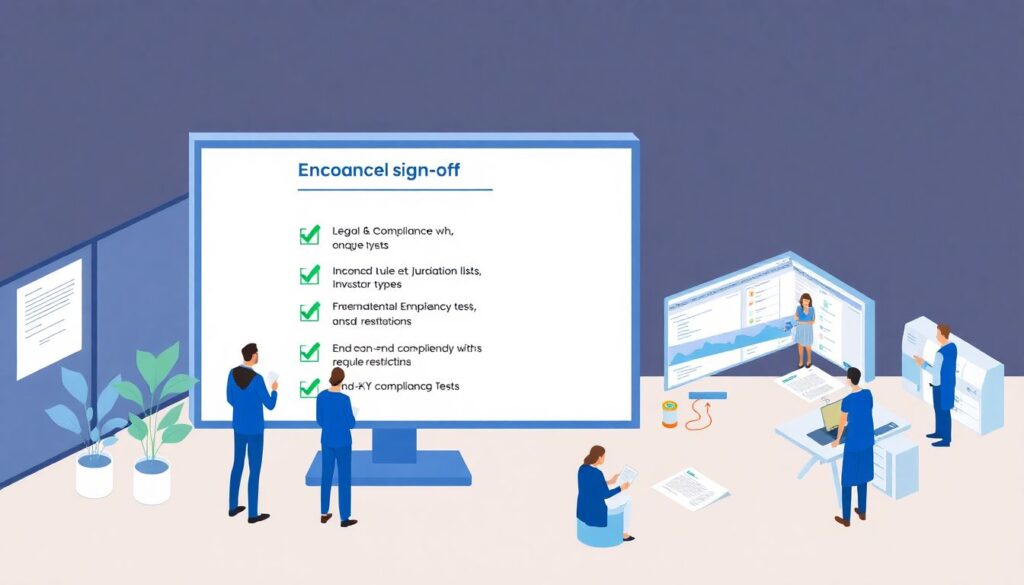
1. Confirm that legal and compliance teams have reviewed and signed off the encoded rule set, including jurisdiction lists, investor types and any transfer restrictions.
2. Run end‑to‑end tests of the onboarding flow with internal users and at least a handful of friendly clients, verifying that KYC, wallet whitelisting and token issuance all work smoothly.
3. Execute stress tests on reporting and reconciliation, ensuring that your administrator, auditors and risk teams can all access consistent, up‑to‑date records based on the on-chain ledger.
4. Validate your incident and override procedures so that blocked transactions, system failures or oracle downtime can be handled without improvisation or regulatory surprises.
5. Prepare clear investor communications explaining how the tokenized structure works, what remains the same from a legal perspective and how the automated compliance features protect both the fund and its investors.
When you combine a solid rulebook, robust token architecture, an integrated KYC/AML layer and thoughtful monitoring, blockchain-powered compliance automation for tokenized funds stops being a buzzword and becomes day-to-day infrastructure. You reduce manual work, shrink operational risk and give regulators a transparent, auditable window into how you run the fund — all while making the product more accessible and flexible for the investors who keep your business running.