
Why AI-assisted authentication suddenly matters for crypto wallets
The last bull run taught a painful lesson: people don’t usually lose coins because blockchains are hacked, they lose them because their wallets get compromised. Phishing sites, fake apps, leaked seed phrases, shoulder surfing, deepfakes – the usual mess. By 2025, wallet teams quietly reached the same conclusion: passwords and 12‑word phrases alone just don’t cut it. That’s where AI-assisted user authentication steps in. In plain words, the wallet tries to “understand” if it’s really you, not just someone who knows (or stole) your secret. Instead of a single lock on the door, you get a smart guard that watches patterns, context and biometrics and can say “this looks wrong, let’s double‑check before sending your BTC to nowhere”.
AI-assisted authentication doesn’t replace cryptography, it surrounds it with extra sanity checks.
Key terms, without the marketing fluff
Let’s sync vocabulary first, so we talk about the same things.
A crypto wallet is software (or hardware) that manages private keys and builds signed transactions. Authentication is how the app verifies it’s dealing with the legit user before letting them sign or change settings. AI-assisted authentication means this check is augmented by machine learning models that look at behavior, device signals, biometrics and context. When people say crypto wallet with AI security, in a healthy implementation they mean: “keys are still controlled by strong cryptography, but AI decides when, how and how often to challenge the user, or when to block a suspicious action completely”.
How AI fits into the login and signing flow
Short version: AI scores risk, then the wallet adapts. No magic.
[Diagram 1: high level flow]
User action → (1) Collect signals (device, network, behavior) → (2) Risk engine (ML models) → (3) Decision
→ low risk → “silent” pass
→ medium risk → extra check (PIN, biometric, email)
→ high risk → block + alert
Under the hood, models can run partly on-device (basic anomaly detection) and partly in the backend (heavier models with more data). The wallet doesn’t see your private key; it sees your interaction with the interface and decides how paranoid it should be right now.
Definitions of the building blocks
To understand why some projects claim they’re the best AI powered crypto wallet, it helps to unpack the main pieces. Behavioral biometrics: how you type, swipe, the timing between clicks, even the way you jiggle the mouse. Device fingerprinting: OS version, device model, jailbreak/root signals, language, time zone. Contextual risk: IP reputation, Tor/VPN usage, abnormal location, weird time of day for you. Biometric factors: face ID, fingerprint, voice – especially relevant for any biometric authentication crypto wallet. ML models digest these signals, form a risk score and decide if the next action should be smooth, slightly annoying, or flat-out blocked.
AI vs classic authentication: what actually changes
Traditional wallets mostly rely on static factors: something you know (PIN, password, seed phrase) + sometimes something you have (hardware key or device). This works until the “something you know” leaks, which happens frighteningly often. AI shifts the game from static secrets to dynamic patterns. The system learns your typical behavior – which chains you use, ticket size, frequency, devices – then treats deviations as suspicious. Compared to classic 2FA, AI-driven checks are more continuous: protection isn’t just at login, but at transaction time, settings change, export of keys. The wallet becomes more like a bank’s fraud engine, but tuned for self-custody.
You still sign transactions with keys; AI just controls how easy it is to reach that signing step.
Text diagram: layered defenses in an AI-driven wallet
[Diagram 2: layered security view]
Layer 0: Private key (seed phrase / hardware key)
↓
Layer 1: Local lock (PIN, password, biometrics)
↓
Layer 2: AI risk engine (signals + model)
↓
Layer 3: Adaptive challenge
– low risk → no extra friction
– medium risk → extra biometric / OTP
– high risk → transaction queue + manual review (for custodial setups) or hard block
A secure crypto wallet with advanced authentication tries to keep everyday actions almost frictionless while making high‑risk actions feel like trying to withdraw cash from an ATM on Mars.
Concrete examples of AI-assisted flows
Picture this. You usually move $100–$500 of stablecoins between the same two addresses on weekday evenings, from your phone, in your home city. One night, a transaction appears from a new browser, via a sketchy IP, for $25,000 in a memecoin you’ve never touched. Classic wallet: “Sure, here’s the send button, just confirm.” Wallet with AI: the model flags the combo as abnormal, bumps risk to red, asks for biometric re-auth plus maybe out-of-band confirmation on your phone. If you ignore that alert, it can delay broadcasting the transaction, giving you time to cancel. That’s what good AI fraud detection for crypto wallets looks like in practice – not marketing slides, but a real change in what gets through.
Biometrics, deepfakes and where AI actually helps
Biometrics sound perfect until you remember deepfakes and replica fingerprints. A biometric authentication crypto wallet that naïvely trusts the OS’s face unlock is only as strong as that subsystem. Modern approaches push AI deeper: liveness detection (are we seeing a real 3D face, not a screen), micro‑movement analysis (blink patterns, subtle head motion), and cross-checks with typical device usage. Example: face unlock from a totally new IP, at 3 AM local time, with a browser user-agent that screams emulator – that’s likely to be throttled. AI doesn’t just say “face matches”; it says “face + context + behavior matches what we expect for this user at this moment”.
In other words, biometrics become one noisy input into a larger risk puzzle, not a single point of failure.
Comparing AI-assisted self-custody and custodial wallets
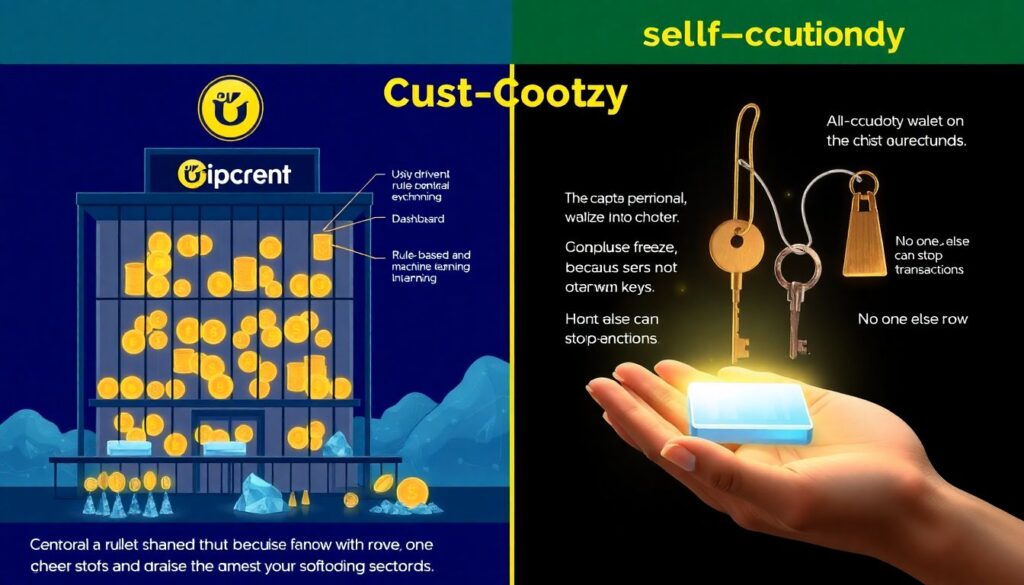
Custodial exchanges have used rule-based and ML fraud systems for years, but you don’t hold keys there, so the service can simply freeze funds. In self-custody, freezing is way more sensitive: the point is that no one can unilaterally stop you from moving coins. A well-designed crypto wallet with AI security walks a thin line: it can slow or require extra confirmation, but not seize control. Think: delay queue for suspicious high-value sends, local notifications on all your devices, or a “panic cancel” button that rebroadcasts a conflicting transaction (where the protocol allows it). The difference with centralized models is who has final authority; AI should advise and protect, not silently overrule ownership.
Threats in 2025 that AI specifically targets
We’re in 2025, and attackers use AI too. Phishing sites are near-perfect clones; emails and messages are written by language models in flawless style; voice calls imitating support agents or even your friends are generated on demand. Malware can run in browser extensions, silently injecting addresses or modifying amounts right before you sign. Static blacklists and simple domain checks feel like duct tape here. ML-based classifiers can look at the DOM structure of dApp frontends, script behavior, and past reports to flag “this website looks legit but smells like prior scams”. Combined with behavior models on your side, the wallet can say: “You’ve never interacted with this dApp, similar ones had bad outcomes, and this transaction empties your account – think twice.”
That’s the sort of contextual warning that actually saves money, not just scares users.
What to look for in an AI-enhanced wallet today
If you’re evaluating a secure crypto wallet with advanced authentication in 2025, ignore fluffy slogans and ask specific questions. Does any model run on-device, or is everything tied to the cloud? How is training data anonymized and stored? Can you see logs explaining why a transaction was flagged as risky? Are there options to tune aggressiveness, like “ultra paranoid for this address, chill for this one”? The label best AI powered crypto wallet means nothing if you can’t clearly see what’s being checked, what’s sent to servers, and how you can opt out. Transparency and user control are core features; without them, the “AI layer” can quietly morph into a surveillance system or, worse, a single point of failure if the vendor disappears.
Privacy, on-device models and regulatory pressure
As regulators in 2025 push harder on KYC/AML, some wallet providers are tempted to fold analytics and identity checks into the same AI stack. That’s risky for privacy and for security culture around self-custody. A healthier pattern is split-brain: local AI models handling behavioral risk and device trust directly on your phone or hardware wallet, while any compliance-related logic lives separately on opt‑in services. Lightweight anomaly detection, such as autoencoders or simple sequence models, can run efficiently on consumer hardware now, so there’s little excuse to stream every micro-interaction to the cloud. The good designs send only coarse signals or hashes, enough to train better defenses without building a dossier on each user’s spending habits.
The goal: personalization without turning wallets into analytics funnels.
Near-future roadmap: 2025–2030
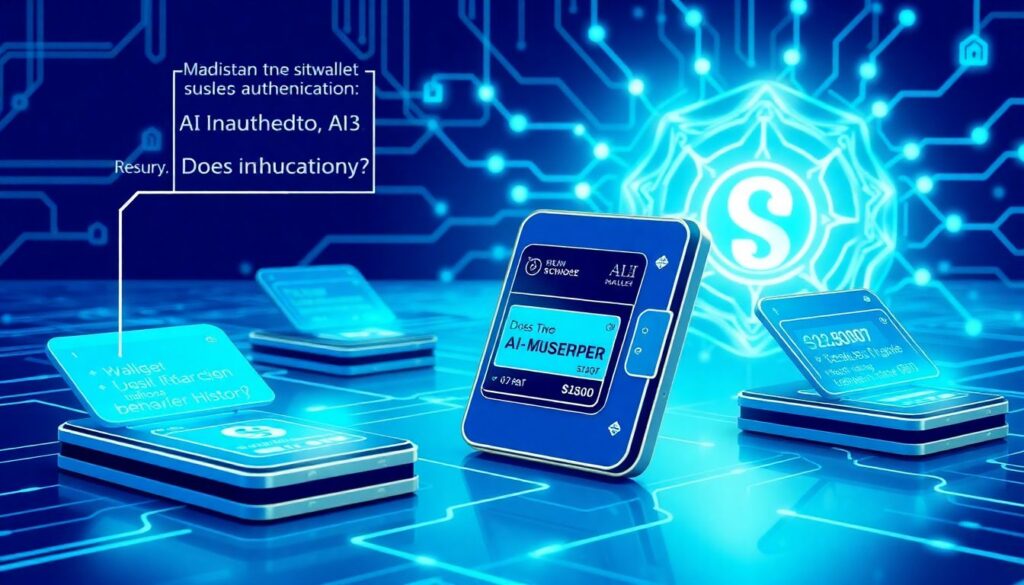
Over the next five years, expect AI-assisted user authentication to become the default in mainstream wallets, much like 2FA did for exchanges. Hardware wallets will likely embed simple behavioral models in their secure elements, adding “does this interaction fit history?” checks before displaying confirmation screens. Multi-sig and smart-contract wallets will get smarter policies: a low-value daily allowance with soft checks, but automatic time-locks and multi-device prompts for large or unusual transfers. We’ll also see more cooperative security – several wallets and providers sharing anonymized signals about fresh scams, feeding into shared detection models. If this plays out well, AI fraud detection for crypto wallets becomes less of a premium feature and more of the baseline safety net you just assume is there.
Final thoughts for builders and users
For developers, the interesting challenge in 2025 is balance: powerful models, but explainable decisions; strict checks, but escape hatches and offline modes. For users, the mental model needs a nudge: you still own your keys, but now your wallet is more like a cautious co-pilot that occasionally says “This doesn’t look like you, prove it is.” Used correctly, AI shifts security from brittle secrets toward resilient patterns, nudging crypto UX closer to the safety people expect from mature banking apps, without sacrificing self-custody. If that balance holds, “AI-assisted authentication” will become something we barely mention – it’ll just be how secure wallets work.