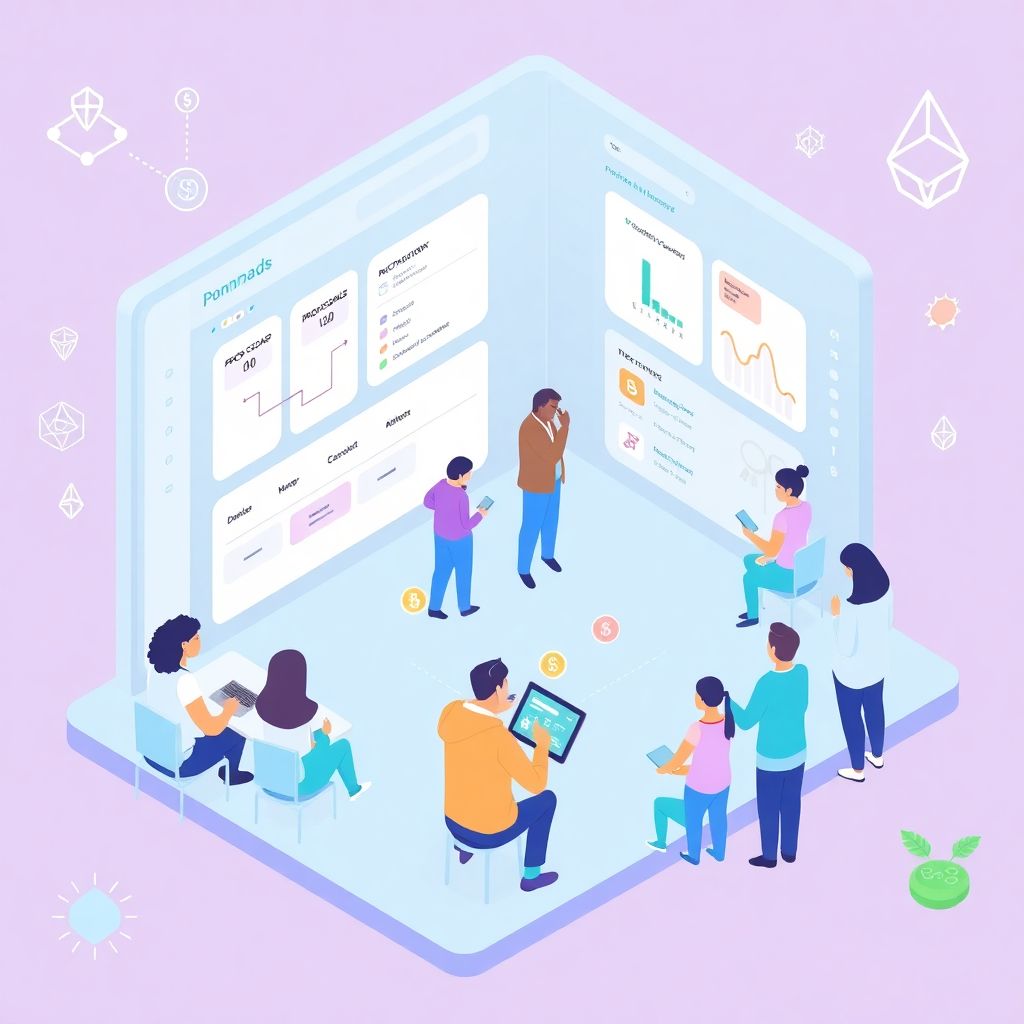
Why governance tooling matters for social impact DAOs
If you strip away the buzzwords, a social impact DAO is just a group of people trying to fund and manage good projects together, using crypto rails instead of bank accounts and spreadsheets. Autonomous governance tooling is the glue that keeps this from turning into chaos. It decides how money moves, who gets a voice, and how trust is built (or lost) without a traditional hierarchy.
When the tools are designed well, a DAO can onboard volunteers quickly, coordinate donors transparently, and route funds to the right places with minimal friction. When the tools are clunky, everything slows down: voter apathy grows, proposals get stuck, and core contributors burn out running manual processes.
Short historical tour: from “token votes on everything” to specialized tooling
Early experiments: simple tokens, complex politics
The first wave of DAO tooling around 2016–2019 was painfully basic. Think: one token, one vote, simple proposals, and very limited automation. Most decisions required manual execution by a multisig or a core dev, even when a vote had passed. As a result, these DAOs felt more like community forums glued to a shared wallet than a true DAO governance platform for social impact or anything else.
Social good projects jumped in quickly—community grant funds, mutual aid groups, advocacy collectives—but they ran into a few problems:
– Gas costs made voting expensive and discouraged participation from smaller holders.
– Voter turnout was low, because every decision felt like work.
– High-context operational decisions were dumped into low-context on-chain votes.
The tools simply weren’t built for nuanced impact work that often needs fast decisions, local context, and trust in domain experts.
DeFi maturity, impact DAOs catch up
As DeFi protocols scaled, governance stacks got more sophisticated: timelocks, on-chain execution, delegation, and modular frameworks like Aragon, DAOstack, Compound Governor, and later Safe + Zodiac modules. Social impact builders piggybacked on these, adapting them for grants, bounties, and community treasuries.
That’s when the idea of dedicated web3 governance tooling for impact DAOs really started to take shape: plug‑and‑play components that a non-technical nonprofit could use to run a DAO without hiring a Solidity engineer for every change.
Core principles of autonomous governance for impact DAOs
Principle 1: Automation where trust is fragile, flexibility where trust is strong
Impact DAOs usually sit in a weird spot: people trust each other more than in anonymous DeFi, but less than a tight-knit nonprofit board. So you want to automate the pieces most likely to cause disputes and keep human discretion where context matters.
Automate:
– Treasury movements after a passed vote
– Grant payout schedules and milestones
– Role-based spending limits and permissions
Keep flexible:
– Project selection and prioritization
– Emergency responses (disasters, crises)
– Long-term strategy and partnerships
A good social impact DAO platform for community funding doesn’t try to automate every judgment call. It automates the boring but sensitive parts—money flows, permissions, record‑keeping—so humans can focus on evaluating impact.
Principle 2: Governance should be usable by non-crypto people
If only “web3 natives” can figure out your interface, you’ve already lost 80% of potential volunteers, domain experts, and even donors. For many nonprofits, the ideal experience is: log in with an email or social login, see the proposals relevant to you, understand them in 30 seconds, and click once to vote or approve.
That means autonomous DAO governance tools for nonprofits must:
– Abstract away chains and wallets where possible
– Explain transactions in human language (“Send 1000 USDC to X if milestone Y is confirmed”)
– Offer low-friction participation (off-chain or gasless voting, multi-device access)
If your process requires people to manage 12-word seed phrases just to approve a $2000 grant, most real‑world organizations will check out.
Principle 3: Minimize governance, maximize guardrails
A common mistake is to “governance everything”—constant votes on operational details. Effective DAOs flip this: governance sets up guardrails and frameworks; execution happens inside them without further approval.
Typical structure:
– Community votes to adopt a grants framework (budget range, eligibility, review process).
– Elected reviewers or pods make individual grant decisions within that framework.
– Automation enforces the boundaries: no grant above X, no payout until Y, etc.
The more your framework is encoded in the DAO governance platform for social impact, the less you need to drag everyone to the polls for routine choices.
What this tooling looks like in practice
1. Proposals and decision workflows
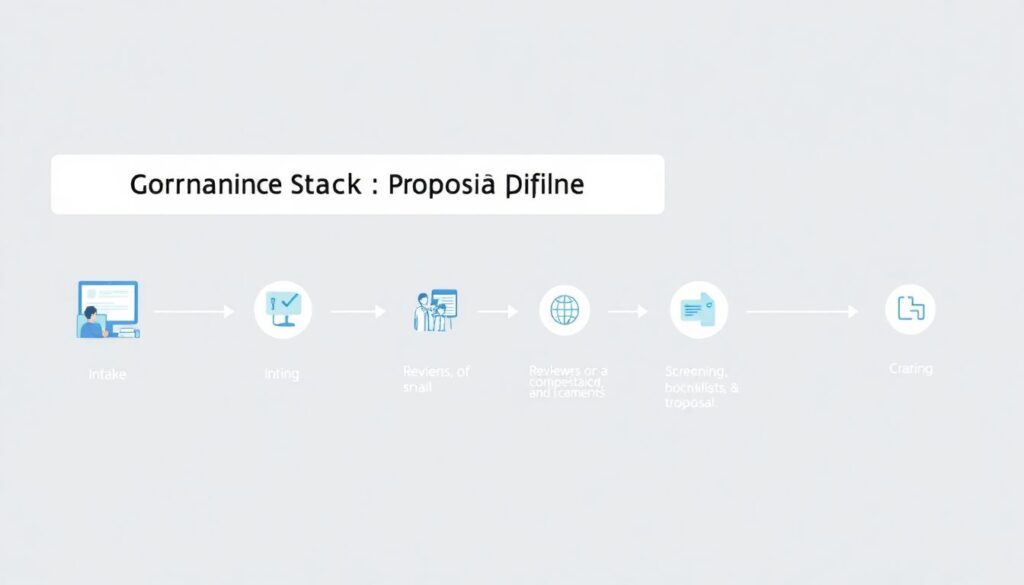
At the heart of any governance stack is the proposal pipeline. For impact DAOs, this should mirror the way grantmakers and nonprofits already work, with clearer traceability.
Typical flow:
1. Intake – Someone submits a project idea or funding request through a web form or interface.
2. Screening – A small group (reviewers, council, pod) checks basic fit and eligibility.
3. Deliberation – Discussion happens in public channels with clear summaries.
4. Decision – Depending on scope, this might be a community vote, council vote, or delegated authority.
5. Execution – Smart contracts move funds, set up vesting, and log everything.
Modern web3 governance tooling for impact DAOs often lets you configure multiple “tracks”: fast‑track microgrants, standard grants, and strategic initiatives with deeper due diligence.
2. Treasury and payouts
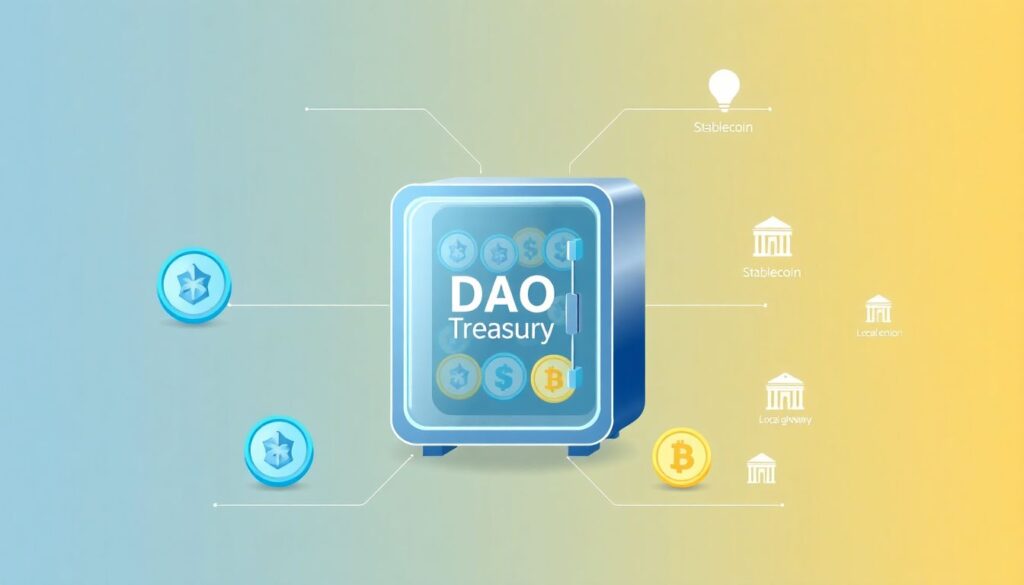
This is where tooling either saves or ruins your operations. A social impact DAO rarely has a single homogeneous treasury; it may juggle:
– Stablecoins for predictable funding
– Volatile assets from donors or ecosystem partners
– Local on/off‑ramp constraints for specific countries
The best DAO software for social impact organizations integrates:
– Multisig or modular wallets (e.g., Safe) for secure custody
– On‑chain rules for recurring payouts, cliff/vesting schedules, milestone-based unlocks
– Role-based permissions so project leads can manage expenses within capped budgets, without asking the entire DAO for each payment
When this is wired correctly, a passed proposal automatically schedules the correct payouts, with clear logs and auditability for donors and regulators.
3. Roles, pods, and contributor management
Real work in DAOs gets done in small groups, not in all‑hands votes. Good governance tooling embraces that.
Common patterns:
– Pods or subDAOs – Topic-based groups (e.g., Climate Grants Pod, Community Events Pod) with delegated budgets and decision power.
– Working groups – Short-lived formations around a campaign, event, or region.
– Reputation or non-transferable badges – Indicating expertise (e.g., impact evaluation, legal, finance) and gating certain roles or permissions.
In practice, this might look like: the grants pod has authority to approve any application under $10k; anything higher goes to a snapshot-style community vote; all of it flows through the same interface so the history is consistent.
4. Impact tracking baked into governance
For social impact DAOs, impact metrics aren’t a nice-to-have—they’re your accountability layer. The trick is to link impact reporting directly to funding logic.
Examples of how tooling can handle this:
– Proposals must define a small set of measurable outcomes and a reporting schedule.
– Payouts are split into tranches; each tranche requires a simple, structured milestone report.
– Reviewers can approve or reject milestone completion, triggering automatic payouts or escalations.
Over time, these reports create a shared evidence base. You can see which types of projects—by region, theme, or partner type—consistently achieve outcomes, and adjust your frameworks without rewriting every contract manually.
Examples of governance tooling in real-world settings
Small community grants DAO
Imagine a local climate collective with 100 active members and a few major donors. They use a social impact DAO platform for community funding to distribute $200k per year in microgrants to grassroots projects.
Tooling in action:
– Off-chain voting with on-chain execution – Proposals and votes happen off-chain (cheaper, user-friendly), but once approved, the tool triggers a transaction from the DAO treasury.
– Predefined grant categories – Preconfigured templates for “Education,” “Reforestation,” and “Community Events,” each with suggested budgets and required fields.
– Lightweight reputation – Volunteers who have successfully run projects earn a badge; their future proposals get fast-track review.
Autonomy here means the group doesn’t need to ask developers every time they tweak grant sizes or update evaluation criteria; most governance parameters live in configurable modules.
Network of aligned nonprofits
Now scale it up: a coalition of 15 nonprofits coordinating climate resilience funds across continents. Each org has its own legal entity but they share a part of their budgets in a collective DAO.
Their stack might include:
– A shared treasury governed by coalition votes
– Sub-accounts (or subDAOs) for regional pods that execute local programs
– Transparent, shared reporting so each org can see how the joint pool is used
Here, autonomous DAO governance tools for nonprofits need to play nicely with existing systems: payroll, accounting software, and traditional grant agreements. A lot of the value comes from permissioned access and exportable data, not just “on-chain purity.”
Common misconceptions and how to avoid them
“Full autonomy” means “no humans in the loop”
One of the most persistent myths is that “autonomous” equals “fully automated, no human decision-making.” For social impact DAOs, this is both unrealistic and dangerous. You *need* humans to assess complex trade-offs, deal with local law, and adapt in crises.
Better mental model:
Autonomous governance = humans set and adjust the rules; software enforces them consistently and transparently.
Tooling should make it trivial to see:
– Who can change which parameters
– How those changes are approved
– What the current rules are at any given moment
You’re not eliminating human governance; you’re encoding it once, so you don’t have to re‑negotiate it on every decision.
“More voters = more democracy = better outcomes”
It’s tempting to measure “decentralization” by voter count. In practice, constant all‑member voting:
– Exhausts people
– Encourages low‑information decisions
– Pushes complex issues into simplistic yes/no choices
Well-designed DAO governance platforms shift from “everyone votes on everything” to:
– Delegation to trusted reviewers or councils
– Scoped authority (pods, working groups)
– Escalation: the wider DAO steps in only for high-impact or contentious decisions
Your governance is more democratic when people can meaningfully participate where they have context, not when they’re spammed with votes.
“We just need to pick the right all-in-one platform”
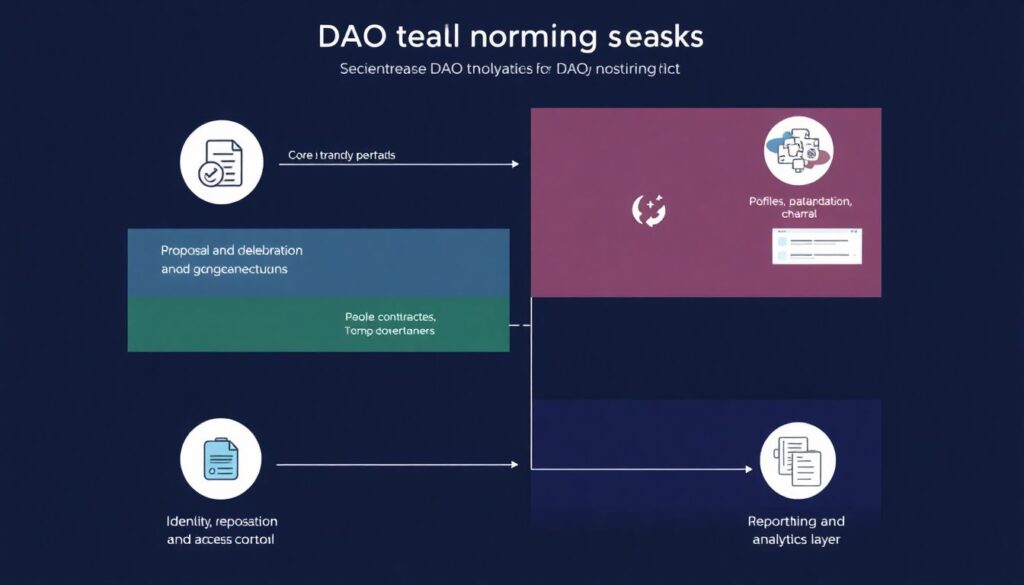
Another trap: treating tooling as a single product choice. In reality, a mature stack is usually a combination of:
– Core treasury and execution layer
– Proposal and deliberation layer
– Identity/reputation and access control
– Reporting and analytics
The “best DAO software for social impact organizations” is often a small, well-integrated bundle of tools that your team actually understands, not an enormous monolith full of features nobody uses. Prioritize interoperability and clarity over buying the most feature-rich product.
“On-chain = transparent = compliant”
On-chain transparency is powerful, but it doesn’t automatically solve compliance, especially for nonprofits and NGOs operating in multiple jurisdictions. Regulators care about:
– Beneficiary due diligence (KYC/AML where applicable)
– Source and destination of funds
– Record-keeping and auditability in formats they recognize
Good tooling helps bridge this gap: tagging on-chain transactions with off-chain identifiers, exporting reports in familiar formats, and mapping DAO decisions to legal entity actions. Don’t assume that “it’s on Ethereum” will satisfy an auditor on its own.
How to choose and implement governance tooling step by step
Step 1: Start from your governance design, not the tools
Before you even look at products, define:
– Who should have a say in which decisions?
– What are your funding flows (donor → treasury → projects)?
– Where are the trust bottlenecks today?
Sketch this on paper. Only then look for a DAO governance platform for social impact that matches your actual needs instead of forcing you into a generic pattern.
Step 2: Map your “minimum autonomy” target
Ask: “If we went offline for a week, what should still work?” That’s your baseline for automation.
Typical candidates:
– Recurring grants or stipends already approved
– Ongoing program funding with clear milestones
– Routine reimbursements under defined caps
Start by automating these low-risk flows. Leave big strategic choices for later once your community has more experience with the tools.
Step 3: Pilot with a single program or pod
Don’t rebuild your entire org in one go. Pick a self-contained program:
– One grants track
– One regional pod
– One thematic fund (e.g., youth education)
Implement governance tooling just for that scope, measure participation and friction, and refine your frameworks before scaling out.
Step 4: Measure not just “uptime,” but human outcomes
Beyond technical reliability, pay attention to:
– Are more contributors able to propose and lead projects?
– Are decisions faster without sacrificing deliberation quality?
– Do donors and beneficiaries understand how and why funding decisions are made?
If the answer to these is “yes,” your autonomous governance setup is doing its job—even if you’re only using a small slice of possible features.
Where this is heading
Over the next few years, expect governance stacks to become more modular and context-aware. Instead of “one big DAO,” you’ll see networks of small, specialized pods wired together, with tooling that quietly handles:
– Routing proposals to the right reviewers
– Suggesting decision modes based on past patterns
– Generating audit-ready trails in the background
As this matures, a lot of the complexity will sit below the surface. From the user’s point of view, joining an impact DAO will feel less like “learning web3” and more like joining a modern, transparent cooperative—with rails that just happen to be on-chain.
For social impact builders, the key is to treat autonomous governance not as a buzzword, but as a design practice: decide where humans add irreplaceable value, then use technology to automate everything around that. The right mix of web3 governance tooling for impact DAOs can make your organization more open, more accountable, and surprisingly efficient—without asking people to become blockchain experts just to do meaningful work.